Are Grams the Same as Milliliters?
Are Grams the Same as Milliliters?
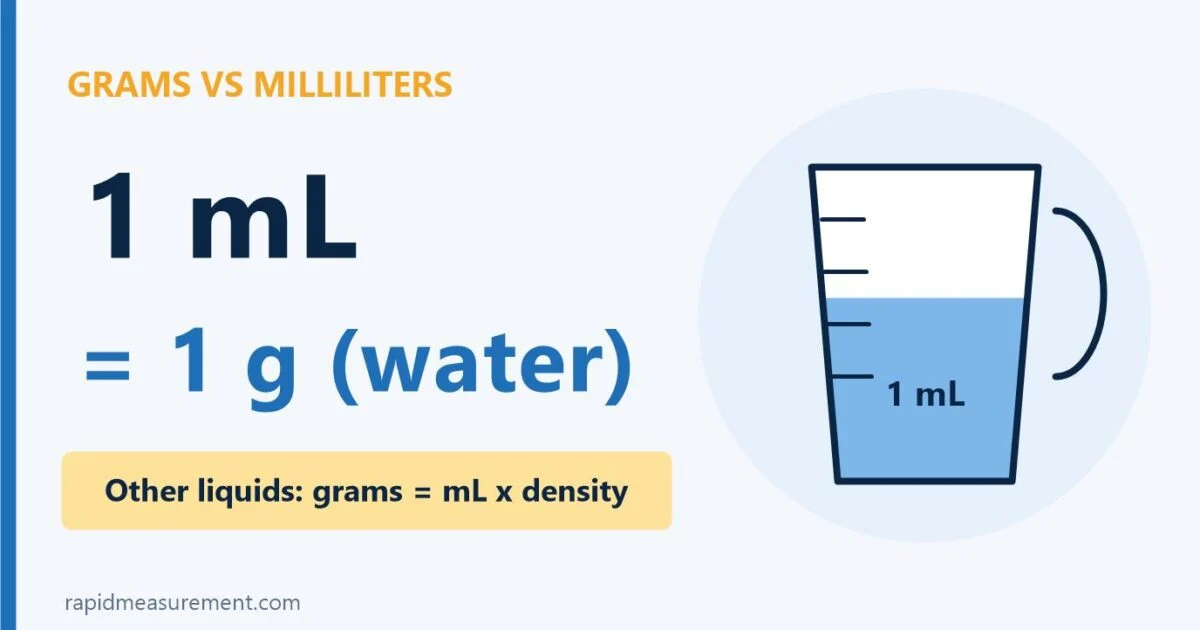
No — grams and milliliters measure two different things. A gram is a unit of mass (how much matter something contains). A milliliter is a unit of volume (how much space something takes up). They’re not interchangeable, even though recipes and product labels throw both around like they are. For a general reference, see the Wikipedia entry on density.
The confusion isn’t random, though. There’s one very common substance where the two numbers do line up — and that’s exactly where this mix-up comes from.
Why Everyone Assumes They’re the Same
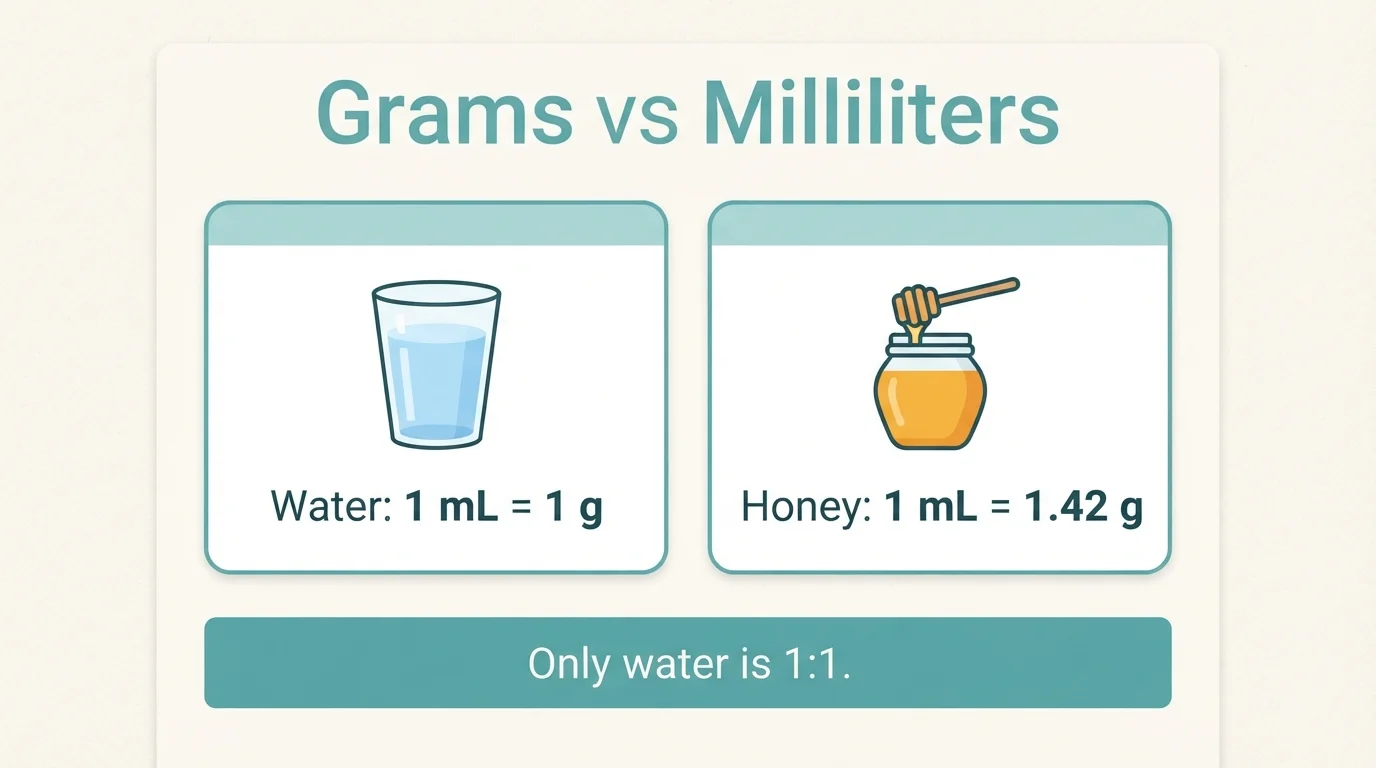
Water has a density of exactly 1 gram per milliliter. So 100 mL of water weighs precisely 100 grams. No math needed, no conversion factor — they just match.
Because so many recipes and drinks are water-based, people quietly start assuming grams and milliliters are always equal. They’re not. Water is the exception, not the rule.
The Real Relationship: Density
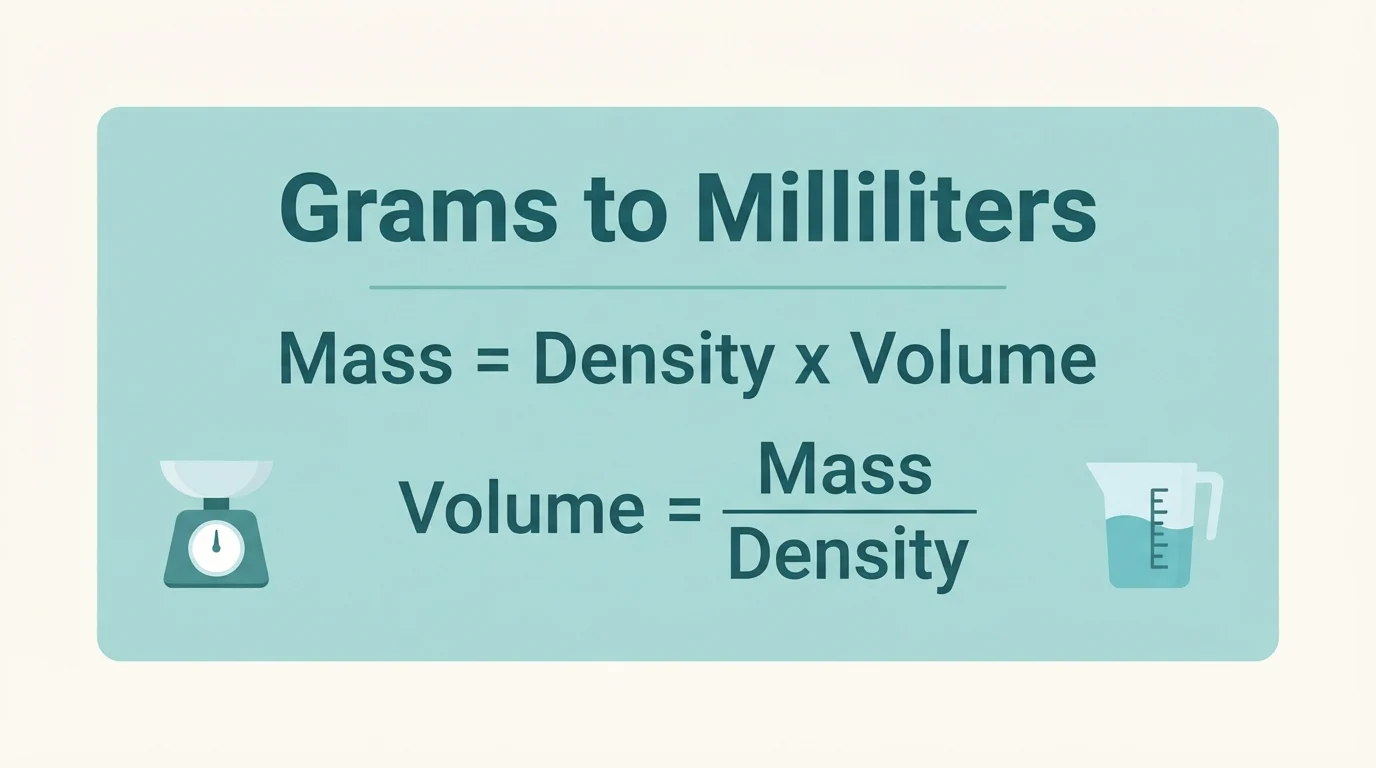
What actually connects mass and volume is density — how tightly packed a substance’s matter is. The formula is:
Mass (g) = Density (g/mL) × Volume (mL)
Rearranged, to go from grams to milliliters:
Volume (mL) = Mass (g) ÷ Density (g/mL)
Once you know a liquid’s density, converting between the two takes one line of math.
Density Chart for Common Kitchen Ingredients
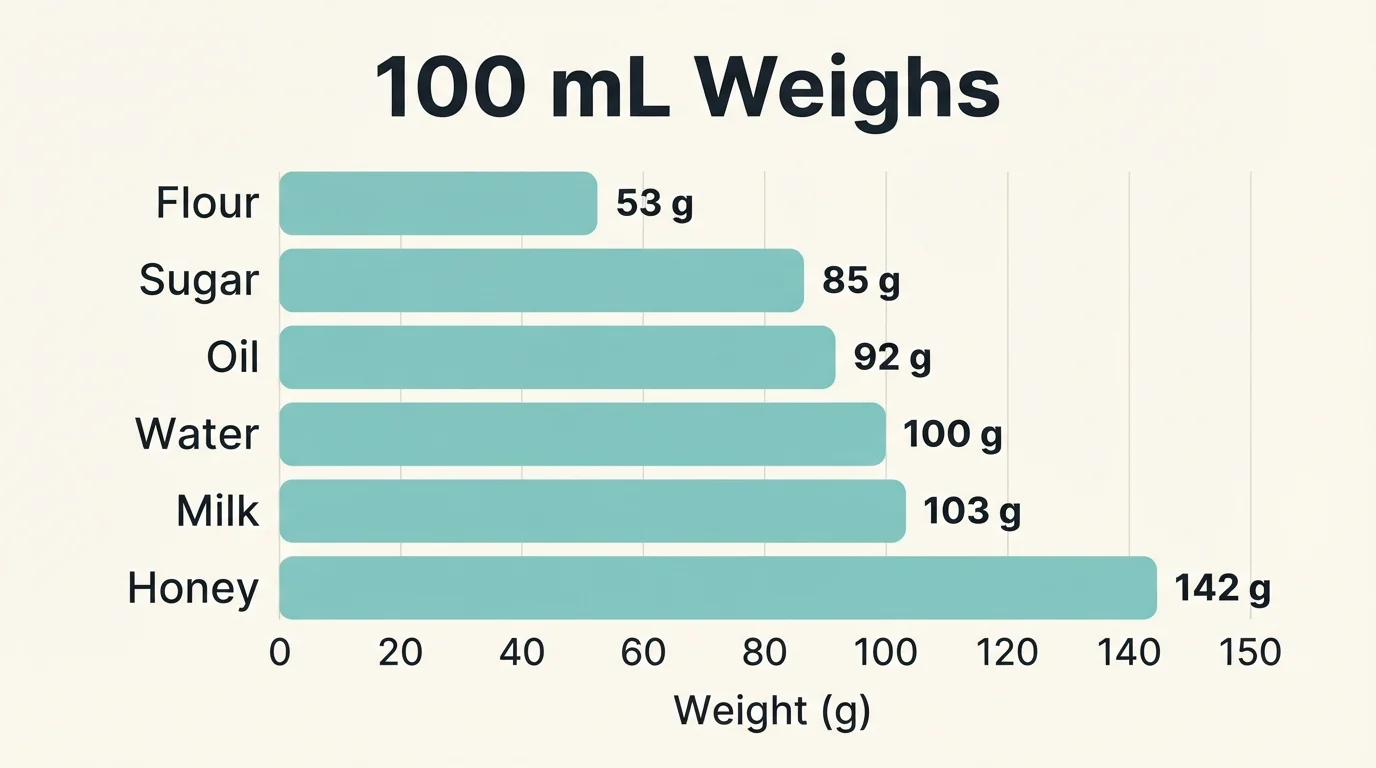
Here’s how far some everyday liquids and ingredients drift from the water-based 1:1 assumption:
| Ingredient | Density (g/mL) | 100 mL Weighs |
|---|---|---|
| Water | 1.00 | 100 g |
| Milk | 1.03 | 103 g |
| Vegetable oil | 0.92 | 92 g |
| Honey | 1.42 | 142 g |
| Maple syrup | 1.32 | 132 g |
| All-purpose flour | 0.53 | 53 g |
| Granulated sugar | 0.85 | 85 g |
| Rubbing alcohol | 0.79 | 79 g |
Look at flour and honey — they sit on opposite ends. 100 mL of flour weighs about half of 100 mL of honey. Treating them as equal would throw off a recipe badly.
Worked Example: Converting Honey
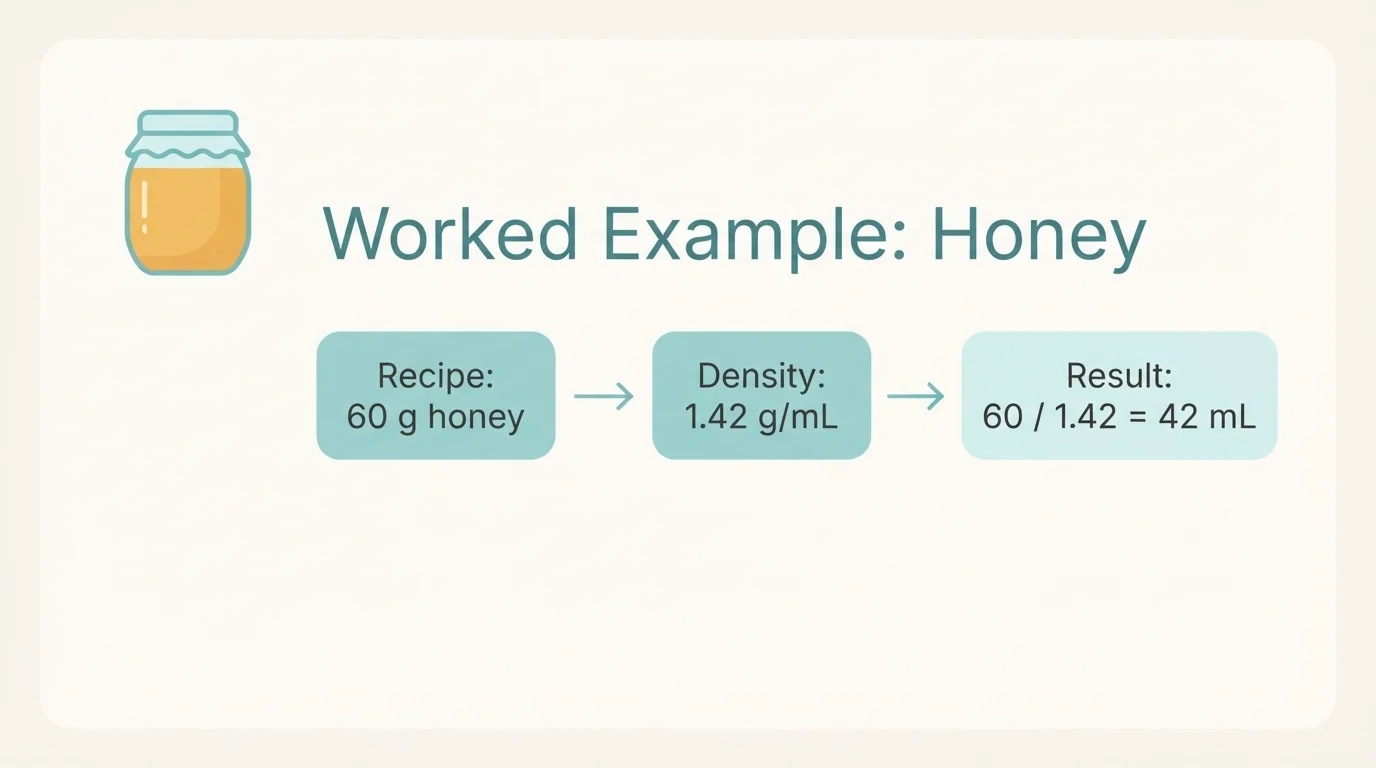
Say a recipe calls for 60 grams of honey, but your measuring tools only show milliliters. Using honey’s density (1.42 g/mL):
60 g ÷ 1.42 g/mL ≈ 42 mL
Without accounting for density, guessing “60 mL” would give you noticeably more honey than the recipe wants.
When Is It Safe to Treat Them as Equal?
For liquids that are mostly water — milk, juice, broth, vinegar — treating grams and milliliters as a 1:1 match is close enough for everyday cooking. The error is small.
For anything thicker, oilier, or sugar-heavy — honey, syrup, oil, melted butter, flour — the gap is too big to ignore, especially in baking, where ratios matter for how a recipe turns out.
Grams vs. mL in Medicine and Supplements
This isn’t just a kitchen problem. Liquid medications are usually dosed by mass — a label might say “500 mg per dose” — but the bottle comes with a mL-marked syringe or cup. The concentration printed on the label (like “250 mg/5 mL”) is what bridges the two, and it’s different for every medicine.
Mixing this up matters more here than in cooking: assuming 1 mL always equals a fixed number of milligrams, regardless of the actual medication, is how dosing errors happen. Always measure liquid medicine using the concentration on its own label, not a general rule of thumb.
Where This Mistake Causes Real Problems
- Baking: Flour and sugar measured by volume instead of weight are a leading cause of inconsistent results — professional bakers weigh almost everything.
- Medicine dosing: Liquid medications are often dosed by mass (mg) but measured out with a volume-based syringe, so the concentration on the label matters.
- Nutrition labels: Serving sizes listed in grams vs. mL can look inconsistent between similar products if their densities differ.
Frequently Asked Questions
Is 1 gram the same as 1 milliliter?
Only for water. For any other substance, 1 gram and 1 milliliter represent different amounts because they depend on density.
Can I substitute grams for milliliters in a recipe?
Only safely for water-like liquids. For oils, honey, syrup, or dry ingredients like flour and sugar, you need the ingredient’s density to convert accurately.
How do I convert grams to milliliters?
Divide the mass in grams by the ingredient’s density in g/mL. If you don’t know the density, look it up for that specific ingredient — it varies a lot between substances.
Why do grams and milliliters match for water but not honey?
Because water’s density is exactly 1 g/mL, while honey is much denser at around 1.42 g/mL — meaning the same volume of honey weighs more than the same volume of water.
Why do some recipes use grams and others use milliliters for similar ingredients?
Recipe writers often default to whichever unit is easier to measure accurately for that ingredient — weight (grams) for dry or sticky ingredients, volume (mL) for thin, pourable liquids like water or milk.
Is there a dedicated guide to the gram?
Yes — see our full guide to the gram for its history and everyday uses.
Related Articles
10 Kilograms to Pounds: 10 kg = 22.05 lb
10 kilograms equals 22.05 pounds. See the formula, a 5-15 kg table, what weighs 10 kg and how to stay under a 10 kg cabin bag limit.
200 Pounds to Kilograms: 200 lb = 90.72 kg
200 pounds equals 90.72 kilograms. Get the formula, a 180-220 lb table, ladder and boxing limits, and a quick mental estimate.
150 Pounds to Kilograms: 150 lb = 68.04 kg
150 pounds equals 68.04 kilograms. See the formula, a 130-170 lb table, how height changes what 150 lb means, and an easy estimate.
100 Pounds to Kilograms: 100 lb = 45.36 kg
100 pounds equals 45.36 kilograms. Get the lb to kg formula, a table from 80 to 120 lb, shipping tips and a quick way to estimate it.