Mass vs. Weight: What’s the Real Difference?

What Is the Difference Between Mass and Weight?
If you’ve ever wondered what is the difference between weight and mass, you’re not alone — it’s one of the most searched questions in basic science. Most people use “mass” and “weight” interchangeably, but in physics, they mean two very different things. For a general reference, see the Wikipedia entry on mass vs weight.
In this guide, we’ll break down exactly how mass and weight differ, what units measure each one, and how to convert between related measurements — in plain, simple language.
What Is Mass?

Mass is the amount of matter an object contains. It tells you how much “stuff” is packed into something — atoms, molecules, everything that makes it physically exist.
- Mass is measured in kilograms (kg), grams (g), or milligrams (mg) in the metric system.
- Mass does not change based on location. An object has the same mass on Earth, on the Moon, or floating in space.
- Mass is a scalar quantity — it only has size, no direction.
What Is Weight?
Weight is the force of gravity acting on an object’s mass. Unlike mass, weight depends entirely on gravity — and gravity is different depending on where you are.
- The scientific unit of weight is the newton (N), since weight is a force.
- In everyday language, people often measure weight in kilograms or pounds — technically incorrect in physics, but common in daily use (like on a bathroom scale).
- Weight changes depending on gravity. The same object weighs less on the Moon and almost nothing in deep space — even though its mass never changes.
Mass vs. Weight: Key Differences
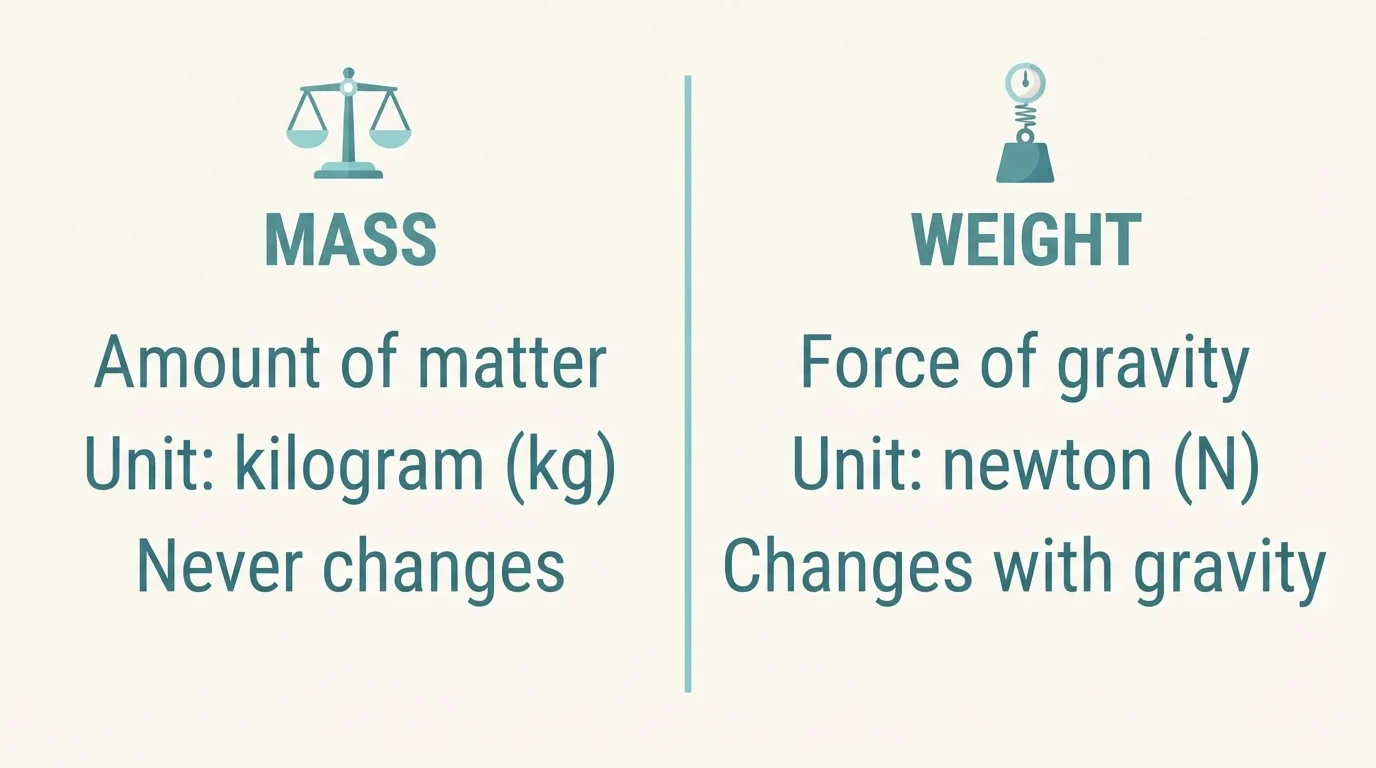
| Property | Mass | Weight |
|---|---|---|
| Definition | Amount of matter in an object | Force of gravity on that matter |
| SI Unit | Kilogram (kg) | Newton (N) |
| Changes with location? | No — always constant | Yes — depends on gravity |
| Type of quantity | Scalar | Vector (has direction — toward gravity) |
| Measuring tool | Balance scale | Spring scale |
Is Weight and Mass the Same Thing?
No — weight and mass are not the same thing, even though they’re closely related and often confused. Mass is a fixed property of matter, while weight is a force that depends on gravity. On Earth, the two are often used interchangeably because gravity is roughly constant everywhere on the planet’s surface, but scientifically, they measure completely different things.
How Are Mass and Weight Related? (The Formula)

Weight and mass are connected through a simple formula:
Weight (W) = Mass (m) × Gravity (g)
On Earth, gravity (g) is approximately 9.8 m/s². So an object with a mass of 10 kg has a weight of:
10 kg × 9.8 m/s² = 98 N (newtons)
This is why the same object would weigh far less on the Moon, where gravity is only about 1.6 m/s² — roughly one-sixth of Earth’s gravity — even though its mass stays exactly the same.
What Units Are Used to Measure Mass?
The most common units used to measure mass are:
- Kilogram (kg) — the SI (metric) base unit of mass, and the figure you’d convert if you ever need to know something like 100 kilograms in pounds
- Gram (g) — used for smaller amounts (1 kg = 1,000 g)
- Milligram (mg) — used for very small/precise amounts (1 g = 1,000 mg)
- Pound (lb) and ounce (oz) — commonly used in the US customary system, though technically these are units of weight/force in strict physics; there are 16 ounces in every pound
- Metric ton (tonne) — used for very large masses (1 tonne = 1,000 kg)
How to Find the Mass of a Liquid
Finding the mass of a liquid is simple once you know its volume and density. The formula is:
Mass = Density × Volume
For example, water has a density of 1 gram per milliliter (1 g/mL). So 250 mL of water has a mass of exactly 250 grams. For other liquids, you’ll need to look up their specific density (oil, milk, and alcohol all differ from water) and multiply it by the volume in milliliters or liters — which is also why grams and milliliters aren’t actually the same thing once you move past plain water.
The easiest practical method: place an empty container on a kitchen or lab scale, zero it out (tare), then pour in the liquid — the scale will read the mass directly.
Does Your Weight Really Change on the Moon?
Yes — and this is the clearest real-world example of the mass vs. weight difference. An astronaut with a mass of 80 kg weighs about 784 N on Earth, but only about 130 N on the Moon — roughly one-sixth as much — because the Moon’s gravity is much weaker. Their mass never changes; only their weight does, because weight depends on gravity, not on the amount of matter in their body.
Your Weight Around the Solar System

Because weight depends on gravity, the same person’s weight looks completely different from planet to planet. Here’s what an 80 kg person (176 lb on Earth) would weigh elsewhere, based on each planet’s surface gravity:
| Location | Surface Gravity | Weight of an 80 kg Person |
|---|---|---|
| Mercury | 3.7 m/s² | 296 N (≈ 30 kg-equivalent) |
| Mars | 3.7 m/s² | 296 N (≈ 30 kg-equivalent) |
| Earth | 9.8 m/s² | 784 N (≈ 80 kg-equivalent) |
| Jupiter | 24.8 m/s² | 1,984 N (≈ 202 kg-equivalent) |
| The Moon | 1.6 m/s² | 128 N (≈ 13 kg-equivalent) |
Notice that the person’s mass stays exactly 80 kg on every single row — only the weight (and how heavy they’d feel) changes.
Common Mass vs. Weight Mistakes
A few habits keep the confusion alive, even among people who know the difference:
- “How much do you weigh?” — technically asking for weight, but almost everyone answers with a mass figure (kilograms or pounds), not a force in newtons.
- Nutrition labels list ingredient amounts in grams — that’s mass, not weight, even though packaging sometimes says “net weight.”
- Bathroom scales measure the force your body exerts on them (weight), then do the math to display a mass figure in kg or lb for convenience.
None of these are “wrong” in casual conversation — language evolved around Earth’s constant gravity, long before anyone needed to distinguish the two. The distinction only starts to matter once gravity isn’t constant anymore, like in space.
Frequently Asked Questions
What is the difference between weight and mass?
Mass is the amount of matter in an object and stays constant everywhere. Weight is the force of gravity acting on that mass, and it changes depending on location (Earth, Moon, space, etc.).
Is weight and mass the same thing?
No. They are related but different — mass is measured in kilograms and never changes, while weight is a force (measured in newtons) that depends on gravity.
What is the unit for measuring mass?
The standard SI unit for mass is the kilogram (kg). Smaller amounts are measured in grams (g) or milligrams (mg).
What is the metric unit for mass?
The metric (SI) base unit for mass is the kilogram (kg).
How do you find the mass of a liquid?
Multiply the liquid’s density by its volume (Mass = Density × Volume), or measure it directly using a scale with the “tare” function.
Why do astronauts feel weightless in space, if they still have mass?
Because weightlessness describes the absence of a supporting force under free fall, not the absence of mass. An astronaut in orbit still has all their normal mass — there’s just no gravity pulling noticeably harder on one side of their body than the other, so they feel weightless even though they aren’t massless.
Final Thoughts
Understanding the difference between mass and weight isn’t just a science-class technicality — it explains real phenomena like why astronauts float in space and why the same object “weighs” differently on different planets. It even applies to something as ordinary as how much a horse weighs — the number on a scale is always gravity acting on mass, whether that mass belongs to an astronaut or a 1,200-pound Thoroughbred. Remember the simple rule: mass never changes, weight depends on gravity. Once that clicks, the rest of the confusion disappears.
Related Articles
250 Pounds to Kilograms: 250 lb = 113.4 kg
250 pounds equals 113.4 kilograms. See the formula, a 200-300 lb table, chair and gym equipment limits, and a quick way to estimate it.
120 Pounds to Kilograms: 120 lb = 54.43 kg
120 pounds equals 54.43 kilograms. Get the lb to kg formula, a 100-140 lb table, body weight and boxing context, and an easy estimate.
90 Kilograms to Pounds: 90 kg = 198.42 lb
90 kilograms equals 198.42 pounds. See the formula, a 80-100 kg table, how 90 kg compares with 200 lb, and a simple mental shortcut.
20 Kilograms to Pounds: 20 kg = 44.09 lb
20 kilograms equals 44.09 pounds. Get the formula, a 10-30 kg table, airline baggage tips for a 20 kg limit and a quick mental shortcut.