What Is a Sensor? Types, Examples & How They Work

What Is a Sensor?
A sensor is a device that detects a physical quantity, such as temperature, pressure, light, or motion, and converts it into a signal that can be read or measured, usually an electrical signal. A digital thermometer, for example, uses a sensor whose electrical resistance changes with temperature; the electronics convert that change into the number on the display.
For background, see the sensor entry on Wikipedia.
Common Types of Sensors

| Sensor Type | Measures | Examples |
|---|---|---|
| Temperature | Heat | Thermocouple, RTD, thermistor |
| Pressure | Force per area | Tire pressure sensor, barometer |
| Light | Brightness | Photodiode, phone ambient light sensor |
| Motion | Acceleration, rotation | Accelerometer, gyroscope |
| Proximity/distance | How far away something is | Ultrasonic, infrared, LiDAR |
| Humidity | Moisture in air | Capacitive humidity sensor |
| Force/weight | Load | Load cell, strain gauge |
| Gas | Air composition | Carbon monoxide detector, CO₂ sensor |
Sensors in Everyday Life
A typical smartphone contains an accelerometer (screen rotation, step counting), a gyroscope, a magnetometer (compass), a proximity sensor (turns off the screen during calls), an ambient light sensor, and a barometer in many models. Digital kitchen and bathroom scales use load cells, cars use dozens of sensors for everything from engine temperature to parking distance, and smart thermostats use temperature and humidity sensors.
Active vs Passive, Analog vs Digital
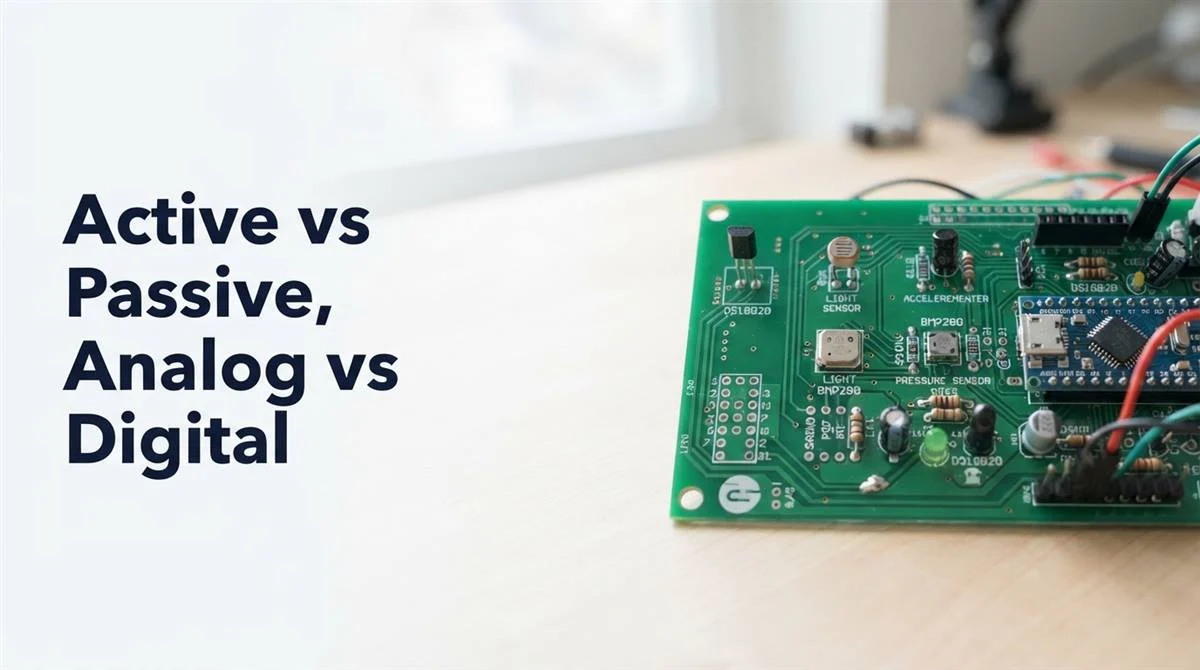
- Passive sensors detect energy already present, such as a thermocouple generating a small voltage from heat.
- Active sensors send out energy and measure the return, such as an ultrasonic distance sensor emitting sound pulses.
- Analog sensors produce a continuously varying signal, like a voltage.
- Digital sensors output numbers directly, often over a data connection.
Key Sensor Specifications
| Specification | Meaning |
|---|---|
| Range | Minimum and maximum values it can measure |
| Sensitivity | How much the output changes per unit of input |
| Resolution | Smallest change it can detect |
| Accuracy | How close its readings are to the true value |
| Response time | How quickly it reacts to a change |
| Drift | How its readings change slowly over time |
Drift is one reason sensors need periodic calibration. For the difference between resolution and accuracy, see resolution vs accuracy.
Sensor vs Transducer
The terms overlap. A transducer converts energy from one form to another; a sensor is a transducer used specifically to measure something. A microphone is a sensor (it measures sound), while a loudspeaker is a transducer that is not a sensor (it produces sound).

Related Topics
See also what is metrology, accuracy vs precision, types of measurement errors, and SI base units.
Frequently Asked Questions
What is a sensor in simple words?
A device that detects something physical, like heat or motion, and turns it into a signal you can measure.
What are the main types of sensors?
Temperature, pressure, light, motion, proximity, humidity, force, and gas sensors.
What sensors are in a smartphone?
Typically an accelerometer, gyroscope, magnetometer, proximity sensor, ambient light sensor, and often a barometer.
What is the difference between a sensor and a transducer?
A transducer converts energy between forms; a sensor is a transducer used to measure something.
Why do sensors need calibration?
Their readings can drift over time, so they must be checked against known references.
FAQ
What is a sensor in simple words?
A device that detects something physical, like heat or motion, and turns it into a signal you can measure.
What are the main types of sensors?
Temperature, pressure, light, motion, proximity, humidity, force, and gas sensors.
What sensors are in a smartphone?
Typically an accelerometer, gyroscope, magnetometer, proximity sensor, ambient light sensor, and often a barometer.
What is the difference between a sensor and a transducer?
A transducer converts energy between forms; a sensor is a transducer used to measure something.
Why do sensors need calibration?
Their readings can drift over time, so they must be checked against known references.
Related Articles

What Is Metrology? The Science of Measurement
Metrology is the science of measurement. Learn its three branches, how traceability and the SI keep measurements consistent worldwide, and where metrology is used.

Resolution vs Accuracy: What’s the Difference?
Resolution is the smallest change an instrument can show; accuracy is how close its reading is to the true value. Learn the difference with examples.

What Is Calibration? Meaning, Process & Examples
Calibration compares an instrument's readings with a more accurate reference standard. Learn how calibration works, calibration vs adjustment, and how often to calibrate.

What Is Measurement Uncertainty? A Simple Guide
Measurement uncertainty is the doubt that exists about any measurement result. Learn Type A and Type B uncertainty, how to combine them, and a worked example.