What Is Linear Feet? Definition & How to Calculate It

What Is Linear Feet?
Linear feet is simply a length measurement in feet, in a straight line, with no width or depth involved. Despite the specialized-sounding name, “linear feet” and “feet” describe exactly the same thing – a linear foot is just a foot. The term exists mainly to make clear that a project is measuring length alone, not area (square feet) or volume (cubic feet).
For background on the base unit, see the foot entry on Wikipedia.
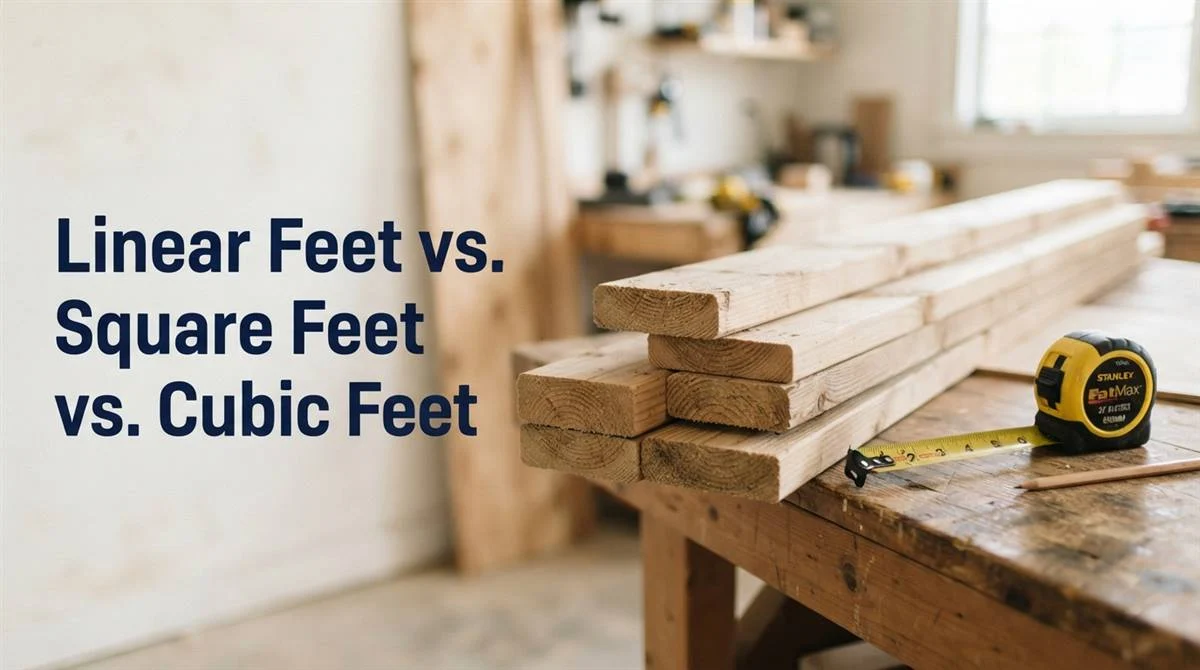
Linear Feet vs. Square Feet vs. Cubic Feet
| Unit | Measures | Example |
|---|---|---|
| Linear feet | Length only (1 dimension) | 10 feet of fencing |
| Square feet | Area (2 dimensions) | 100 sq ft of flooring |
| Cubic feet | Volume (3 dimensions) | 27 cu ft of mulch |
The confusion usually comes from materials that are sold by linear feet even though they cover an area once installed – lumber, fencing, and baseboard trim are priced per linear foot of material, regardless of the board’s width or thickness.
How to Calculate Linear Feet
linear feet = total straight-line length, measured in feet
For a single straight run – a fence line, a wall, a piece of trim – linear feet is just the length you measure directly with a tape measure. For a perimeter (like fencing around a yard), add up the length of every side: a rectangular yard 40 ft by 25 ft needs 40 + 25 + 40 + 25 = 130 linear feet of fencing.
Converting Square Feet to Linear Feet for Flooring
linear feet = square feet ÷ board width (ft)
When buying flooring or decking sold by the linear foot but priced or planned by square footage, divide the square footage you need to cover by the width of a single board. Covering 200 sq ft with 6-inch-wide (0.5 ft) boards needs 200 ÷ 0.5 = 400 linear feet of boards, before accounting for waste from cuts.
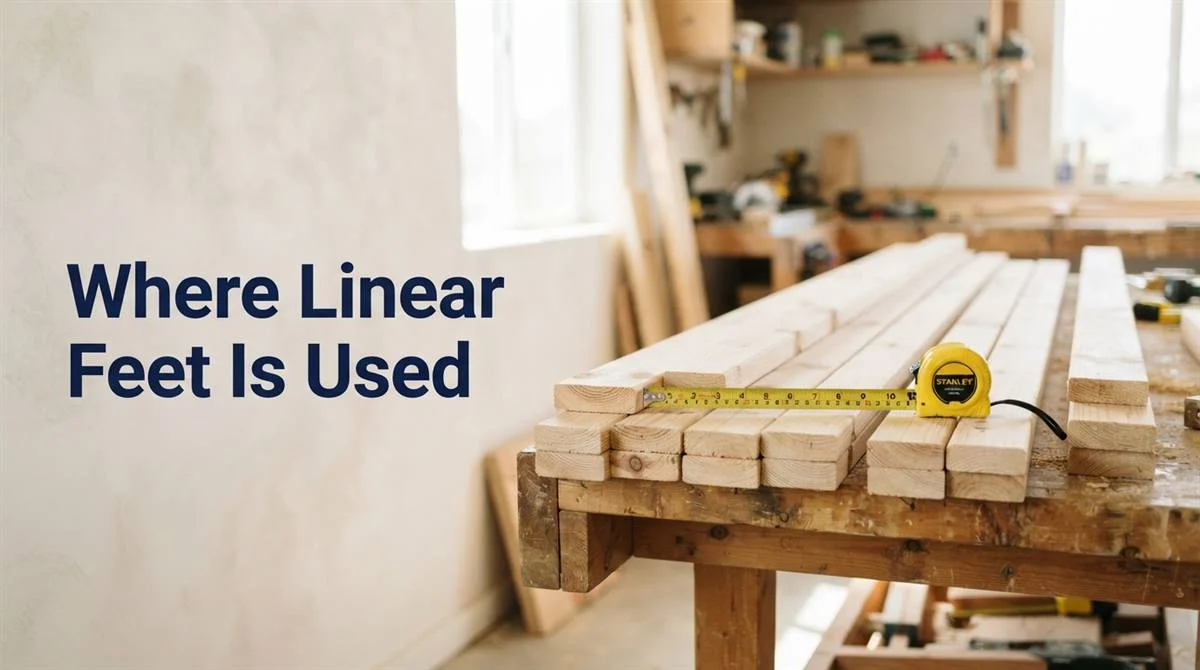
Where Linear Feet Is Used
| Application | Why Linear Feet |
|---|---|
| Lumber and trim | Priced by length regardless of board width |
| Fencing | Priced by the total perimeter length to enclose |
| Countertops | Often quoted per linear foot for a standard depth |
| Moving/storage | Truck and storage unit space sometimes sold by linear feet of wall space |
| Cabinetry | Kitchen cabinets frequently quoted per linear foot of run |
Why Materials Are Priced This Way
Selling lumber, trim, and fencing by the linear foot makes sense because the manufacturing cost scales mainly with length – a 2×4 twice as long costs roughly twice as much regardless of small variations in width. It also lets buyers compare prices easily: “$2 per linear foot” is a simple, comparable number, whereas pricing by square footage would require factoring in the board’s specific width every time, which varies by product and isn’t always the number a buyer cares about.
Worked Example: Ordering Baseboard Trim
Say a room measures 12 ft by 10 ft, with one 3-foot doorway opening. The perimeter is 12 + 10 + 12 + 10 = 44 linear feet. Subtracting the doorway (which needs no trim) leaves 44 – 3 = 41 linear feet of baseboard required. Most trim is sold in fixed board lengths (commonly 8, 12, or 16 feet), so the final step is figuring out how many boards of a given length add up to at least 41 linear feet, then rounding up to a whole number of boards – four 12-foot boards give 48 linear feet, comfortably covering the 41 feet needed with a small margin for waste at the cuts.

Common Mistake: Confusing Linear Feet With Square Feet
The most frequent error is treating a linear-foot price as if it already accounts for coverage area. Ten linear feet of 12-inch-wide flooring covers 10 square feet, but ten linear feet of 4-inch-wide flooring covers only about 3.3 square feet – the same length of material, very different amounts of floor covered. Always check the board or material width before converting between linear feet and square feet.
Related Conversions
See also how to calculate square feet and cubic feet to cubic yards for the area and volume equivalents of this same base unit.
Frequently Asked Questions
Is a linear foot the same as a regular foot?
Yes. A linear foot is exactly the same length as a regular foot; the word “linear” just clarifies that only length is being measured, not area or volume.
How do you convert square feet to linear feet?
Divide the total square footage by the width (in feet) of the material being used – for example, boards or trim of a known width.
How many linear feet of fencing do I need for a 1-acre lot?
It depends on the shape, since linear feet measures perimeter, not area. A perfectly square 1-acre lot (about 208.7 ft per side) needs roughly 835 linear feet of fencing (208.7 × 4).
Why is lumber sold by the linear foot instead of by the piece?
Because the amount of wood – and therefore the cost – scales with length. Pricing per linear foot lets a buyer pay proportionally for exactly the length needed rather than a fixed per-board price.
Does linear feet account for the width of a material?
No. Linear feet measures length only. Two products with very different widths can have the same linear-foot measurement while covering very different amounts of area.
FAQ
Is a linear foot the same as a regular foot?
Yes. A linear foot is exactly the same length as a regular foot; the word "linear" just clarifies that only length is being measured, not area or volume.
How do you convert square feet to linear feet?
Divide the total square footage by the width (in feet) of the material being used - for example, boards or trim of a known width.
How many linear feet of fencing do I need for a 1-acre lot?
It depends on the shape, since linear feet measures perimeter, not area. A perfectly square 1-acre lot (about 208.7 ft per side) needs roughly 835 linear feet of fencing (208.7 × 4).
Why is lumber sold by the linear foot instead of by the piece?
Because the amount of wood - and therefore the cost - scales with length. Pricing per linear foot lets a buyer pay proportionally for exactly the length needed rather than a fixed per-board price.
Does linear feet account for the width of a material?
No. Linear feet measures length only. Two products with very different widths can have the same linear-foot measurement while covering very different amounts of area.
Related Articles

How Many Miles Is a 5K? (3.1 Miles + Finish Times)
How many miles is a 5K? A 5K is 3.1 miles (5 kilometers). See average 5K times for walking and running, pace charts and other race distances.

How Many Miles Is 10,000 Steps? (By Height & Pace)
How many miles is 10000 steps? For most adults it is about 4 to 5 miles. See miles by height and stride, walking time and calories burned.

How Many Steps in a Mile? (Walking & Running Chart)
How many steps in a mile? Most adults take 2,000 to 2,500 walking steps per mile. See steps by height, running vs walking, and a formula.

How Many Meters in a Mile? (1,609.34 m Explained)
How many meters in a mile? There are 1,609.344 meters in 1 mile. See a miles to meters chart, the 1600 m vs mile race and nautical miles.