How Big Is 2 Meters? Everyday Things That Size
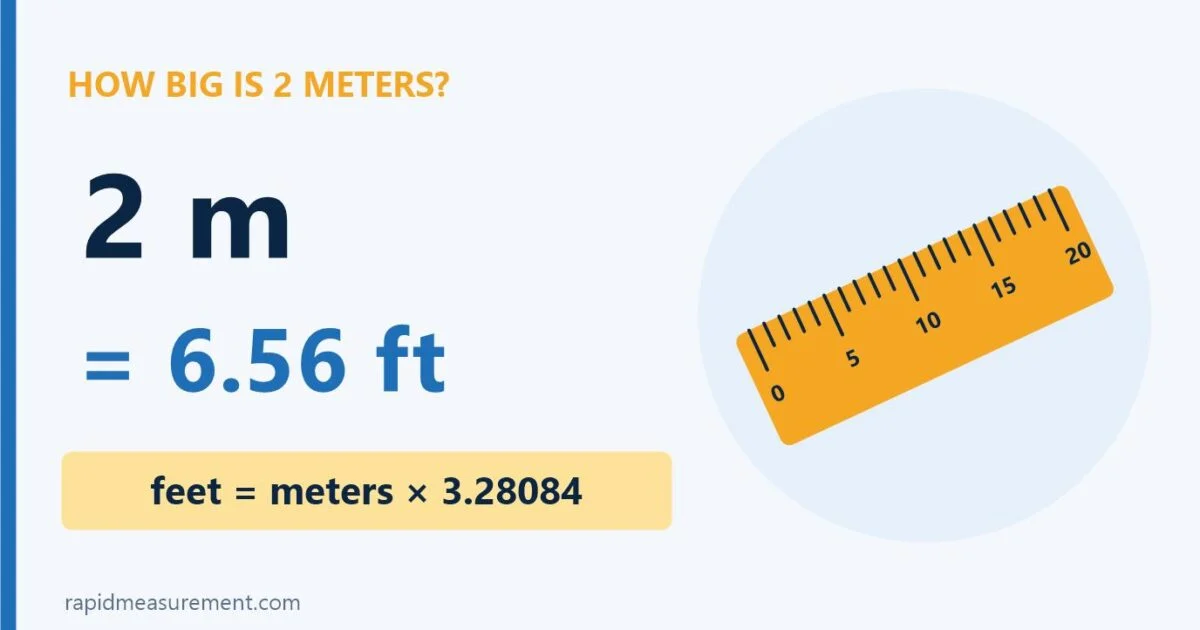
How Big Is 2 Meters?
2 meters (about 6.6 feet) is roughly the height of a tall doorway — a size most people have walked through thousands of times without thinking about the exact measurement. For a general reference, see the Wikipedia entry on meters.
Everyday Things That Are About 2 Meters

- A standard doorway — most interior doors are close to 2 m (6’8″) tall
- A very tall adult — few humans exceed 2 m in height, making it a common benchmark for “very tall”
- A queen-size bed’s length — most queen mattresses measure just under 2 m long
- A large surfboard — longboards commonly measure close to 2-2.7 m
- A pool cue — standard cues measure around 1.45 m, so two cues laid partially overlapping approach 2 m
- A tall bookshelf — many freestanding bookshelves stand close to 2 m tall
- A single-car garage door width — narrower garage doors can measure close to 2-2.4 m wide
Quick Conversion

2 meters equals 6.56 feet, or about 78.7 inches (6 feet 6.7 inches).
How to Estimate 2 Meters Without a Tape Measure
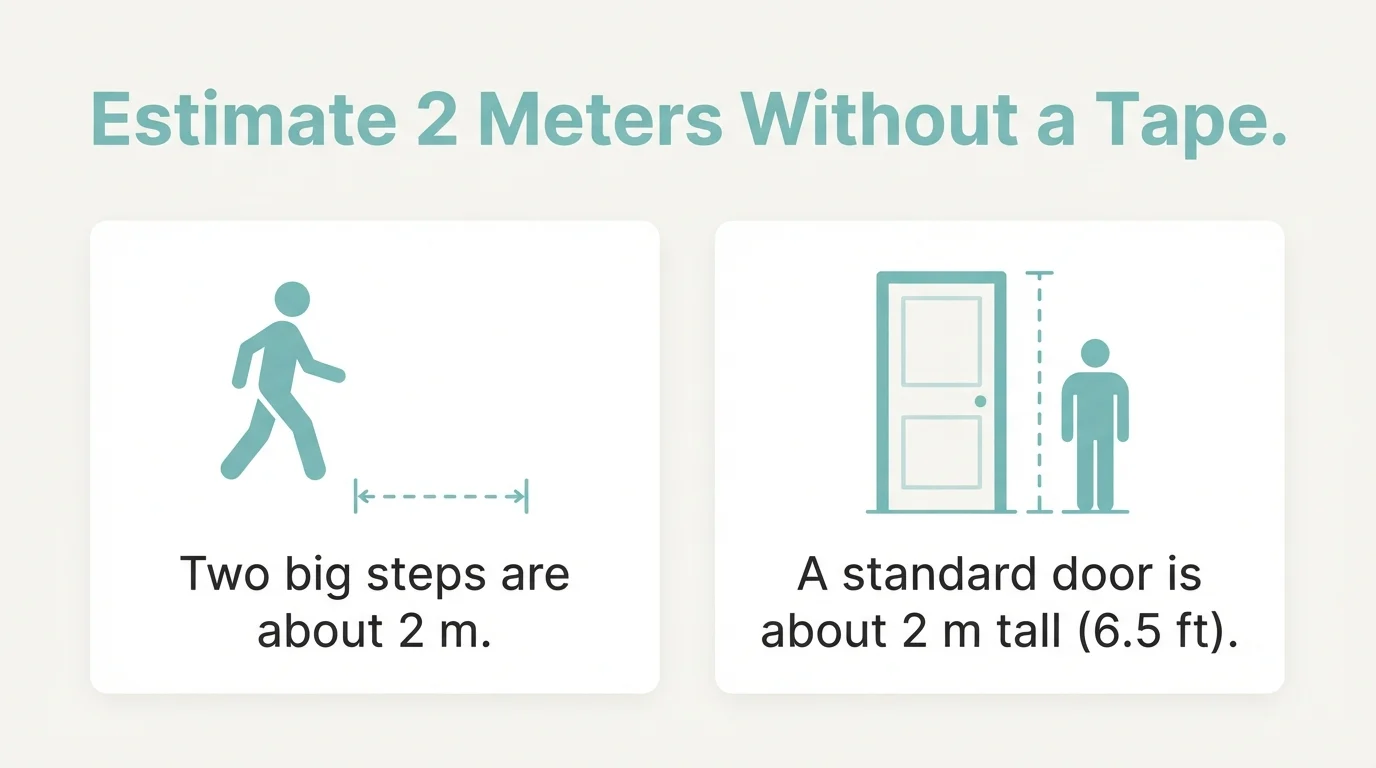
The most reliable everyday reference is a standard interior doorway — nearly all of them are built close to 2 m tall by convention, making them a consistent, always-available measuring stick. For a horizontal reference, two adult strides (walking normally, not stretching) typically cover close to 2 meters.
How Does 2 Meters Compare to Nearby Sizes?
2 meters is exactly 200 centimeters — 200 times the size of the shirt-button-sized 1 centimeter reference point. For a sense of the metric scale in between, our full guide to centimeters walks through the whole range from millimeters up to meters.
2 Meters in Different Contexts
In sports, 2 meters is a notable benchmark — it’s roughly the height of taller professional basketball players, and high jump and pole vault results are often discussed relative to this mark. In furniture and interior design, 2 meters is a common ceiling-height reference in older or smaller homes, while modern builds often run somewhat higher.
Social distancing guidelines during public health emergencies frequently used 2 meters (or its rough equivalent, 6 feet) as a standard spacing recommendation — a reminder of how useful a single, easy-to-visualize length reference can be in everyday communication.
Frequently Asked Questions
How big is 2 meters?
About 6.6 feet — roughly the height of a tall doorway.
What everyday object is 2 meters?
A standard doorway, a queen-size bed’s length, and a tall bookshelf are all close to 2 meters.
How many feet is 2 meters?
2 meters equals approximately 6.56 feet, or 6 feet 6.7 inches.
Is 2 meters taller than the average person?
Yes. The average adult height worldwide is well under 2 meters (roughly 1.6-1.8 m), making 2 m a notably tall benchmark.
How many centimeters is 2 meters?
2 meters equals exactly 200 centimeters.
Is 2 meters the same as 2 yards?
No. 2 meters (about 78.7 inches) is noticeably longer than 2 yards (72 inches) — a difference of nearly 7 inches.
How many yards is 2 meters?
2 meters is approximately 2.19 yards — slightly more than 2 full yards.
How many millimeters is 2 meters?
2 meters equals exactly 2,000 millimeters, following the standard metric scale.
Is 2 meters unusually tall for a doorway?
Slightly. Many modern interior doors are built a touch taller, closer to 2.03 meters, though 2 meters remains the traditional reference point.
Why 2 Meters Feels Like a Natural Benchmark
Doorway height, arm span, and “very tall person” all cluster around 2 meters for a related reason: human-scale architecture and design have always been built around average and above-average body proportions. A doorway needs enough clearance for a tall person to walk through comfortably, which naturally pushes standard door heights toward this figure across cultures and centuries, even before anyone formalized the meter as a unit at all.
This is also why 2 meters keeps reappearing as an informal safety or comfort margin in design guidelines — from ceiling clearances to spacing recommendations — even outside contexts where it’s formally required. It sits just above the range where an average adult would need to duck or squeeze, which makes it a naturally comfortable “enough room” benchmark.
Is there a dedicated guide to the meter?
Yes — see our full guide to the meter for its history and everyday uses.
Related Articles
1 Meter to Feet: 1 m = 3.28 ft
1 meter equals 3.28 feet, or 3 ft 3.37 in. See the formula, a meters to feet table, meter vs yard and a quick mental shortcut.
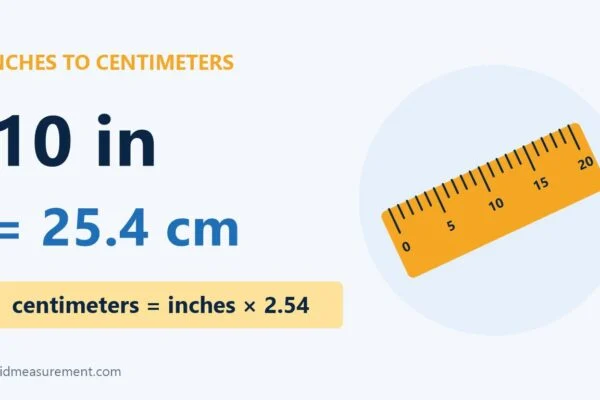
10 Inches to Centimeters: 10 in = 25.4 cm
10 inches equals 25.4 centimeters. Get the formula, a 6-14 inch table, everyday 10 inch objects and a quick mental method.

170 cm to Feet and Inches: 5 ft 6.9 in
170 centimeters equals 5 feet 6.9 inches. See the cm to feet formula, a 160-185 cm height chart and an easy 5-foot anchor trick.
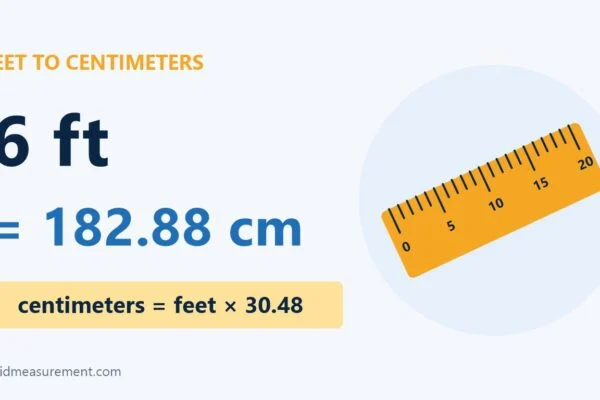
6 Feet to Centimeters: 6 ft = 182.88 cm
6 feet equals 182.88 centimeters. Get the formula, a 6 ft 0 in to 6 ft 5 in height chart in cm and a simple way to convert feet and inches.