What Is a Meter?

What Is a Meter?
A meter (m) is the base unit of length in the metric system — roughly the height of a kitchen countertop, or a bit longer than a yardstick. It’s the unit most of the world uses by default for describing height, room dimensions, and everyday distances. For a general reference, see the Wikipedia entry on meter.
How Big Is a Meter?
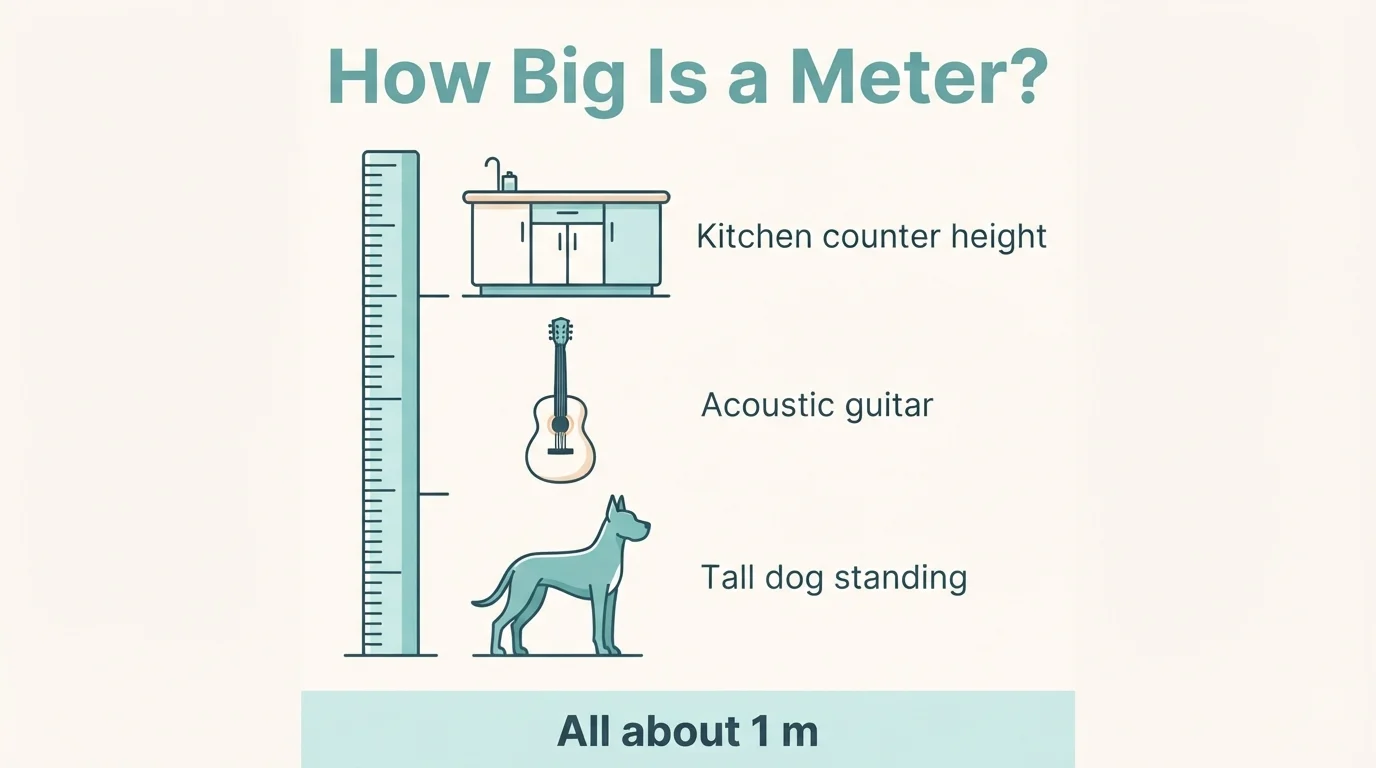
One meter is about 39.37 inches, or just over 3 feet 3 inches. A useful mental image: stretch your arms out to the sides — for most adults, the distance from fingertip to fingertip on one arm’s reach (not both) lands somewhere close to a meter.
| Reference | Approx. Size |
|---|---|
| Kitchen countertop height | ~1 m |
| Yardstick | 0.91 m (slightly under) |
| Guitar (full length) | ~1 m |
| A tall dog standing upright | ~1 m |
Where the Meter Comes From
The meter was defined during the French Revolution in the 1790s as one ten-millionth of the distance from the North Pole to the equator, measured along a meridian through Paris. That definition has been refined several times since — today it’s defined with extreme precision using the speed of light — but the length itself has stayed effectively the same since it was first standardized.
Every other metric length unit is built from the meter as a clean power-of-ten fraction or multiple: a centimeter is one-hundredth of a meter, a millimeter is one-thousandth, and a kilometer is one thousand meters. Learn more about the smaller end of that scale in our full guide to centimeters.
Meters Compared to Other Units

- 1 m = 100 centimeters — see our full centimeters vs. meters comparison.
- 1 m = 1,000 millimeters
- 1 m = 0.001 kilometers — 1,000 meters make a kilometer, covered in our kilometers vs. meters guide.
- 1 m ≈ 3.28 feet — a foot is smaller than a meter, detailed in our feet vs. meters comparison.
- 1 m ≈ 39.37 inches — just over a yard (36 inches).
How Many Meters Are in Common Measurements?

| Measurement | Meters |
|---|---|
| Half a meter | 0.5 m |
| One meter | 1 m |
| Two meters | 2 m |
| Ten meters | 10 m |
| One kilometer | 1,000 m |
Meters in Everyday Use
Meters show up constantly outside the science classroom:
- Height: Most of the world records adult height in meters and centimeters together (like 1.75 m), rather than feet and inches.
- Sports: Track and field, swimming, and most Olympic events are measured entirely in meters.
- Construction: Building plans and room dimensions outside the US are drawn up in meters.
- Fabric: Cloth is commonly sold “by the meter” in most of the world.
Is a Meter Bigger Than a Yard?
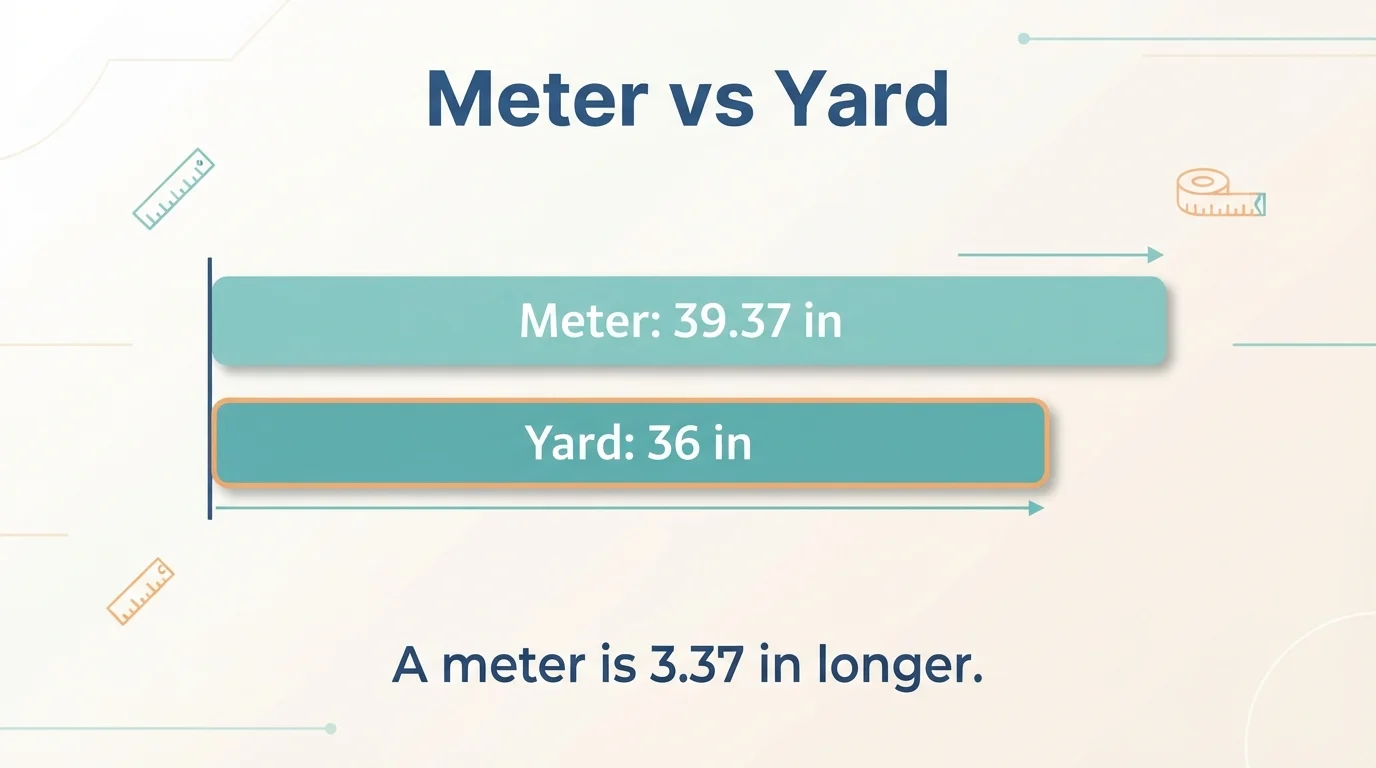
Yes, but only slightly. A meter (39.37 inches) is about 3.37 inches longer than a yard (36 inches) — close enough that people sometimes treat them as interchangeable, but not exact. For anything requiring precision — sewing patterns, construction measurements — that small gap matters.
Meters Around the World
The meter is used as the default length unit in nearly every country on Earth, with the United States being the most notable holdout still relying primarily on feet and inches for daily life. Even in the US, though, meters are the standard in science, medicine, the military, and most manufacturing that involves international trade — which is why American engineers and doctors often switch fluently between both systems depending on context.
This global consistency is one of the meter’s biggest practical advantages: a “2-meter cable” means exactly the same thing whether it’s sold in Germany, Japan, or Brazil, with no regional variation to account for.
Common Meter Mistakes to Avoid
- Confusing meters with yards — they’re close but not identical; treating them as exactly equal introduces a small but real error over longer distances.
- Dropping the decimal point — 1.75 meters (a typical adult height) can easily become “175 meters” if the decimal is misplaced, a massive and obviously wrong distance.
- Mixing meters and centimeters in the same figure incorrectly — “1 meter 75” is shorthand for 1.75 m (175 cm), not 1 meter and 75 meters.
The Meter’s Place in the Metric Family
Understanding the meter unlocks the rest of the metric length system, since every other unit is just a shifted decimal point away from it. Once “1 meter = 100 cm = 1,000 mm = 0.001 km” is second nature, converting between any pair of metric length units becomes simple arithmetic rather than something to look up every time.
Frequently Asked Questions
What is a meter?
A meter is the base unit of length in the metric system, equal to 100 centimeters or about 39.37 inches.
How big is a meter compared to a foot?
A meter is about 3.28 times bigger than a foot.
Is a meter the same as a yard?
Almost, but not exactly. A meter is about 3.37 inches longer than a yard.
How many centimeters make a meter?
Exactly 100 centimeters make one meter.
Why was the meter originally defined using the Earth’s circumference?
The creators of the metric system wanted a length unit based on something fixed and universal rather than a king’s foot or a local custom, so they tied it to the Earth itself — a measurement that, in theory, anyone anywhere could re-derive independently.
How is the meter defined today?
The modern meter is defined using the speed of light — specifically, the distance light travels in a vacuum in 1/299,792,458 of a second. This gives an extremely precise, universally reproducible standard that doesn’t depend on any physical object that could wear down or change over time.
Do all countries agree on exactly how long a meter is?
Yes. The meter is an internationally standardized SI unit, meaning its length is identical everywhere in the world — there’s no regional variation, unlike some historical units that once differed from country to country.
What is the difference between a meter and a metre?
Nothing — they’re the same unit. “Meter” is the American spelling, while “metre” is used in British and most international English. Both refer to the identical length.
Can the length of a meter ever change?
No. Once the international definition was fixed, the meter’s length became permanently locked in — the only thing that has changed over time is the method used to define it with increasing precision, not the actual physical length itself.
Meters in Specific Fields
Different industries lean on the meter in slightly different ways. In construction, meters and millimeters are often used together on the same drawing — overall dimensions in meters, fine joinery details in millimeters, skipping centimeters almost entirely. In physics and engineering, the meter (and its subdivisions) forms the backbone of virtually every formula involving distance, speed, or area, since the entire SI system of units is built outward from it. In everyday retail, appliance and furniture dimensions outside the US are given in meters or centimeters depending on the item’s overall size — a refrigerator’s height in meters, a drawer’s depth in centimeters.
Meters vs. Other Length Units at a Glance
| Unit | Relationship to 1 Meter |
|---|---|
| Millimeter | 1,000 mm = 1 m |
| Centimeter | 100 cm = 1 m |
| Kilometer | 0.001 km = 1 m |
| Foot | 3.28 ft ≈ 1 m |
| Yard | 1.09 yd ≈ 1 m |
Related Articles

170 cm to Feet and Inches: 5 ft 6.9 in
170 centimeters equals 5 feet 6.9 inches. See the cm to feet formula, a 160-185 cm height chart and an easy 5-foot anchor trick.
6 Feet to Centimeters: 6 ft = 182.88 cm
6 feet equals 182.88 centimeters. Get the formula, a 6 ft 0 in to 6 ft 5 in height chart in cm and a simple way to convert feet and inches.
5 Feet to Centimeters: 5 ft = 152.4 cm
5 feet equals 152.4 centimeters. Get the formula, a full 5 ft 0 in to 5 ft 11 in height chart in cm, and an easy way to convert heights.
Feet vs Inches: Difference and How to Convert
Feet vs inches explained: 1 foot is 12 inches. See when to use each unit, worked conversions, a chart in cm and common mix-ups.