Centimeters Explained: Everything You Need to Know

What Is a Centimeter?
A centimeter (cm) is a metric unit of length equal to one-hundredth of a meter, or 10 millimeters. It’s one of the most commonly used units in everyday life — rulers, measuring tapes, and most of the world’s road signs and packaging use it by default. For a general reference, see the Wikipedia entry on centimeters.
If you’ve ever wondered how big a centimeter actually is, how it stacks up against other units, or what counts as “smaller than a centimeter,” this guide covers all of it in one place.
How Big Is a Centimeter?

One centimeter is roughly the width of a standard shirt button, a Cheerio, or your pinky fingernail. It’s small enough that most people can’t guess it precisely by eye, but common enough that a few mental reference points make it easy to estimate.
| Object | Approx. Size |
|---|---|
| Pinky fingernail (width) | ~1 cm |
| Shirt button | ~1 cm |
| Pencil (thickness) | ~1 cm |
| Standard paperclip (width) | ~1 cm |
A Brief History of the Centimeter
The centimeter was born out of the metric system, created in France in the 1790s to replace the tangle of local, inconsistent length units used across Europe at the time. Before this reform, nearly every region — sometimes every town — had its own definition of a “foot” or a “yard,” which made trade, science, and construction needlessly complicated whenever measurements crossed a border.
The system’s designers defined the meter as one ten-millionth of the distance from the North Pole to the equator, then built every other length unit — including the centimeter — as a clean power-of-ten fraction of it. France adopted the system formally in 1795, and it spread across the world over the following two centuries, eventually becoming the basis for the modern International System of Units (SI).
That decimal structure is exactly why the metric system is so easy to calculate with compared to imperial units: converting between centimeters, meters, and kilometers is just a matter of moving a decimal point, with no awkward fractions like 12 inches to a foot or 3 feet to a yard.
Centimeters Compared to Other Units

A centimeter sits right in the middle of the metric length scale — bigger than a millimeter, smaller than a meter:
- 1 cm = 10 millimeters (mm) — a millimeter is smaller than a centimeter, so anything “smaller than a cm” is measured in mm instead.
- 1 cm = 0.01 meters (m) — it takes 100 centimeters to make one meter.
- 1 cm ≈ 0.3937 inches — an inch is bigger than a centimeter, by a little less than 2.5 times.
So is a meter bigger than a centimeter? Yes — a meter is 100 times bigger. Is a centimeter bigger than a millimeter? Also yes — a centimeter is 10 times bigger than a millimeter.
What’s Smaller Than a Centimeter?
Anything under 1 cm typically gets measured in millimeters. A grain of rice (about 6-7mm), a pencil lead tip, or the thickness of a credit card (about 0.76mm) are all smaller than a centimeter. Scientific and medical measurements sometimes go even smaller, into micrometers, but for everyday purposes, millimeters cover almost everything below a centimeter.
How to Read Centimeters on a Ruler
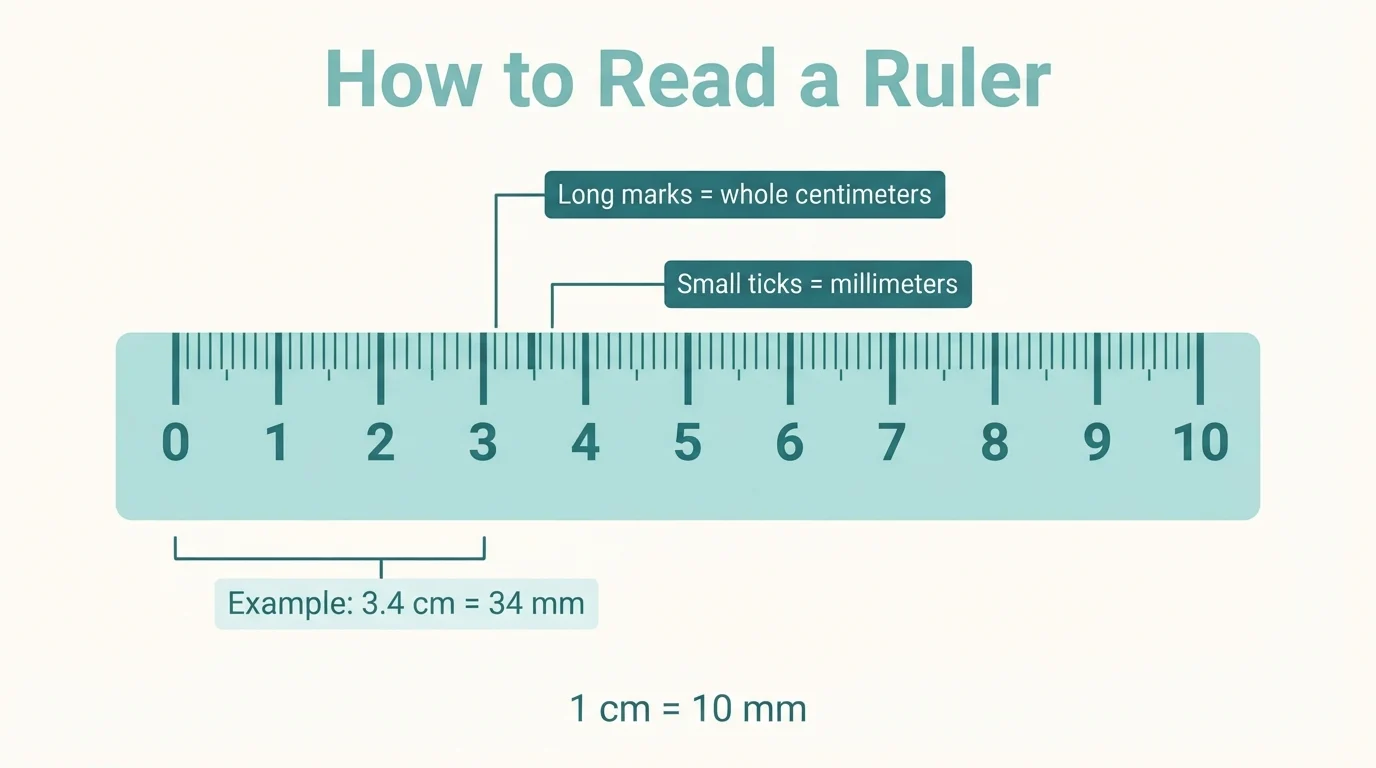
Most rulers mark whole centimeters with a longer line and a number, then divide each centimeter into 10 smaller millimeter ticks. When someone asks “what lengths are marked on this centimeter ruler,” they’re usually looking at those whole-number cm marks — 1, 2, 3, and so on — with the small unlabeled ticks between them representing millimeters.
To read a measurement precisely, count the whole centimeters first, then count the smaller ticks past the last whole number to get the millimeter portion. A length that falls on the fourth small tick past the “3” mark, for example, is 3.4 cm — or 34 mm. Most dual-sided rulers show centimeters on one edge and inches on the other, which is often the fastest way to sanity-check a conversion by eye.
Centimeters in Everyday Use
Beyond the classroom ruler, centimeters show up constantly in daily life:
- Height and body measurements — most of the world records height, waist, and clothing sizes in centimeters rather than inches.
- Sewing and craft projects — seam allowances, fabric cuts, and pattern markings are usually given in centimeters or millimeters for precision.
- Cooking and baking — pan sizes and ingredient dimensions (like a “20 cm cake tin”) are standard outside the US.
- Packaging and shipping — box dimensions on shipping labels are frequently listed in centimeters worldwide.
- Medicine — wound sizes, tumor measurements, and growth charts are recorded in centimeters for consistency between hospitals and countries.
Centimeters Around the World
The vast majority of countries use the metric system, and centimeters, as their default for everyday length. The United States is the most notable exception, still relying on inches and feet for daily life, though even American scientists, doctors, and manufacturers frequently switch to centimeters for precision work. This split is why so many products sold internationally — furniture, electronics, clothing — list both centimeters and inches on the same label.
Common Centimeter Mistakes to Avoid
A few small habits cause most centimeter-related confusion:
- Mixing up cm and mm — a measurement written as “5” without a unit could mean 5 cm or 5 mm, a 10x difference. Always include the unit.
- Forgetting the space — standard notation is “5 cm” with a space, not “5cm,” though both are widely understood.
- Assuming 1 cm ≈ 1 inch — they’re not close; an inch is more than double a centimeter.
- Misreading a ruler’s starting point — some rulers have a small margin before the “0” mark; measuring from the physical edge instead of the true zero throws off the reading.
Common Centimeter Conversions
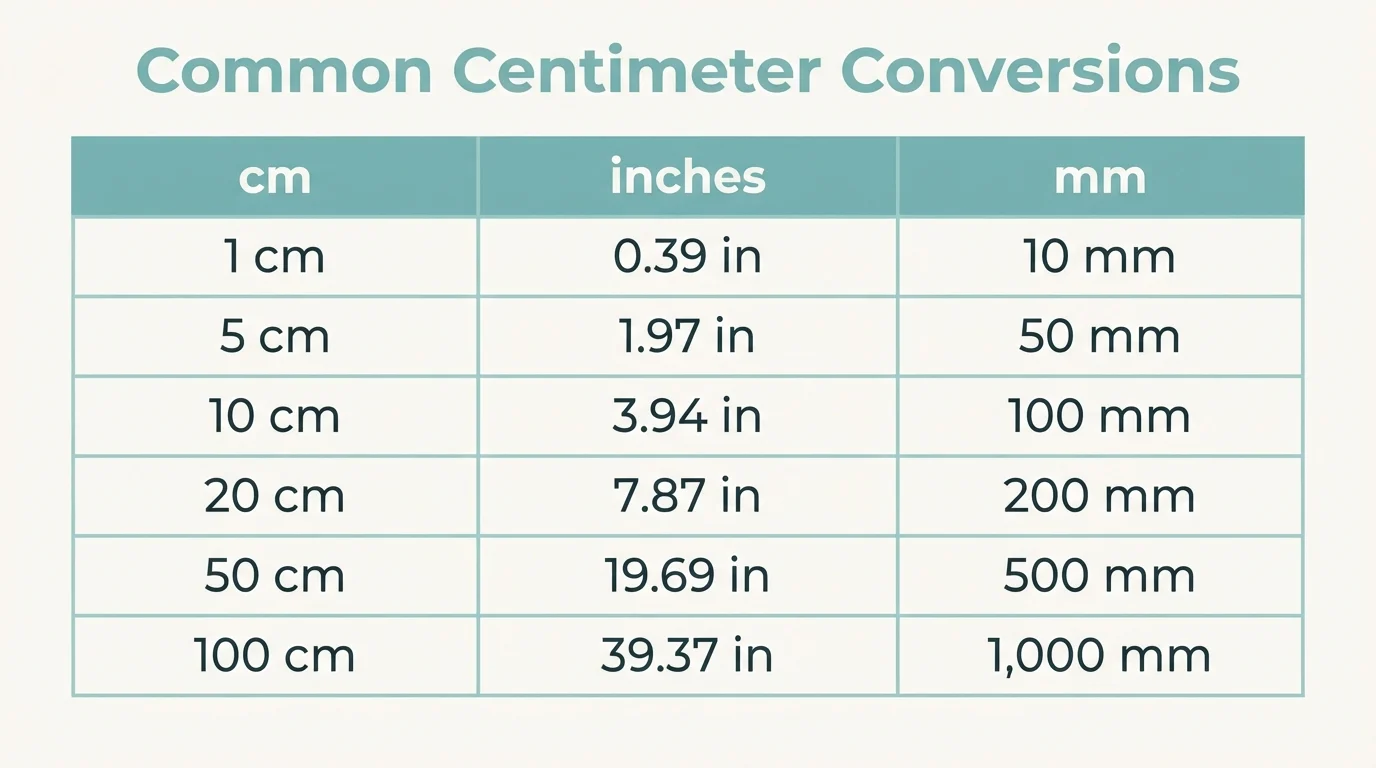
| Centimeters | Inches | Millimeters |
|---|---|---|
| 1 cm | 0.39 in | 10 mm |
| 5 cm | 1.97 in | 50 mm |
| 10 cm | 3.94 in | 100 mm |
| 20 cm | 7.87 in | 200 mm |
| 50 cm | 19.69 in | 500 mm |
| 100 cm | 39.37 in | 1,000 mm |
For an exact conversion of a specific number — like 20 centimeters to inches or 100 centimeters to inches — the math is simple: multiply the centimeter value by 0.3937.
Centimeters vs. Meters, Feet, and Kilometers
Centimeters are part of a bigger family of length units, and mixing them up is one of the most common measurement mistakes. A few quick facts:
- A meter is bigger than a centimeter (100× bigger) — see our full centimeters vs. meters comparison.
- A kilometer is bigger than a meter (1,000× bigger) — covered in our kilometers vs. meters guide.
- A foot (imperial) is smaller than a meter but bigger than a centimeter — see feet vs. meters for the full breakdown.
To get a feel for specific centimeter sizes, our how big is 1 centimeter, 18 centimeters, and 21 centimeters guides each compare a specific length to everyday objects.
Frequently Asked Questions
How big is a centimeter?
About the width of a shirt button or a pinky fingernail — roughly 0.39 inches.
Is a meter bigger than a centimeter?
Yes. A meter equals 100 centimeters, making it significantly bigger.
Is a centimeter bigger than a millimeter?
Yes. A centimeter equals 10 millimeters, so it’s 10 times bigger.
What is smaller than a centimeter?
A millimeter is smaller than a centimeter — there are 10 millimeters in every centimeter.
How many centimeters are in a meter?
There are exactly 100 centimeters in one meter.
Which is greater, cm or m?
A meter (m) is greater than a centimeter (cm) — specifically, 100 times greater.
How big is a quarter in centimeters?
A US quarter is about 2.4 cm across — a little over two centimeters in diameter.
Why does the US still use inches instead of centimeters?
The US never fully converted to the metric system, largely due to the cost and disruption of replacing existing tools, infrastructure, and manufacturing standards built around inches and feet — even though metric use is common in American science, medicine, and the military.
Related Articles
1 Meter to Feet: 1 m = 3.28 ft
1 meter equals 3.28 feet, or 3 ft 3.37 in. See the formula, a meters to feet table, meter vs yard and a quick mental shortcut.
10 Inches to Centimeters: 10 in = 25.4 cm
10 inches equals 25.4 centimeters. Get the formula, a 6-14 inch table, everyday 10 inch objects and a quick mental method.

170 cm to Feet and Inches: 5 ft 6.9 in
170 centimeters equals 5 feet 6.9 inches. See the cm to feet formula, a 160-185 cm height chart and an easy 5-foot anchor trick.
6 Feet to Centimeters: 6 ft = 182.88 cm
6 feet equals 182.88 centimeters. Get the formula, a 6 ft 0 in to 6 ft 5 in height chart in cm and a simple way to convert feet and inches.