Kilometers vs. Meters: Which Is Bigger? (Full Comparison)

Kilometers vs. Meters: Which Is Bigger?
A kilometer is bigger than a meter — exactly 1,000 times bigger. One kilometer equals 1,000 meters, making the kilometer the unit reserved for much longer distances. For a general reference, see the Wikipedia entry on kilometers.
What Is a Meter?
A meter (m) is the base unit of length in the metric system — about the height of a kitchen counter, or a little longer than a yardstick. It’s the everyday unit for rooms, height, and short distances. See our full centimeter and metric length guide for the bigger picture.
What Is a Kilometer?
A kilometer (km) is a larger metric unit built from meters — “kilo” means 1,000. It’s used for distances too long to comfortably describe in meters: the distance between towns, a running race, or a road trip.
The Core Conversion

1 kilometer = 1,000 meters
| Kilometers | Meters |
|---|---|
| 0.5 km | 500 m |
| 1 km | 1,000 m |
| 2 km | 2,000 m |
| 5 km | 5,000 m |
| 10 km | 10,000 m |
How to Convert Between Them

To go from kilometers to meters, multiply by 1,000. To go from meters to kilometers, divide by 1,000.
3 km × 1,000 = 3,000 m | 4,500 m ÷ 1,000 = 4.5 km
Why the Kilometer Exists
The metric system is built entirely on powers of 10, so every unit has a clean “zoom level”: millimeters for tiny things, centimeters and meters for everyday things, and kilometers once distances stretch beyond what a single meter count comfortably describes. Writing “5,000 meters” for a race is technically correct, but “5 kilometers” is the number everyone actually uses.
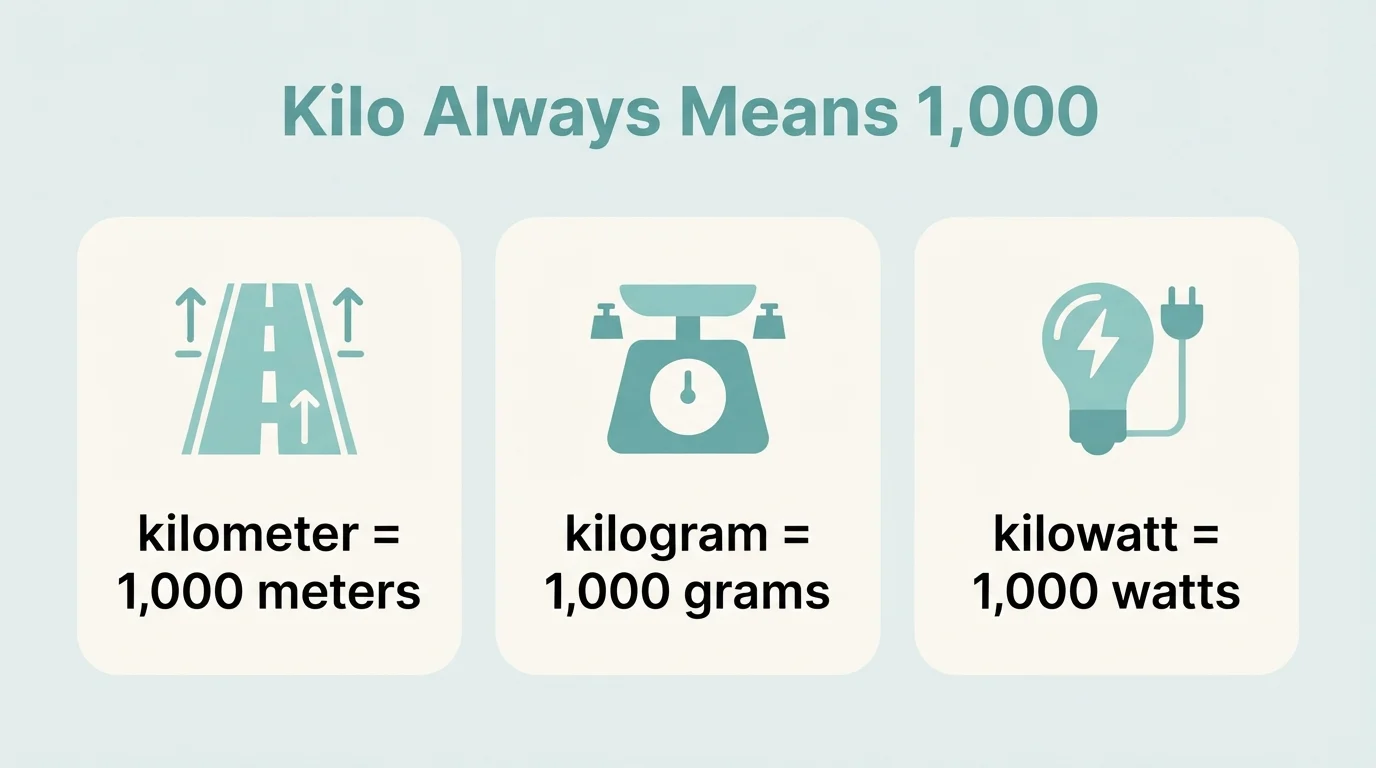
This same pattern repeats throughout the metric system — “kilo” always means 1,000, whether it’s kilometers (1,000 meters), kilograms (1,000 grams), or kilowatts (1,000 watts). Once that prefix clicks, the whole system becomes far easier to navigate, since you’re really only learning one relationship and reapplying it everywhere.
Common Mistakes When Converting
- Losing track of the zeros — 1,000 meters can be easy to mistype as 100 or 10,000 when converting quickly.
- Mixing up km with miles — a kilometer is not the same as a mile (1 mile ≈ 1.609 km), even though both measure longer distances.
- Using kilometers for room-scale measurements — kilometers are the wrong tool for anything smaller than a large outdoor space.
- Forgetting the decimal when going the other way — 750 meters becomes 0.75 km, not 7.5 or 75.
Where This Comes Up in Real Life

- Running and cycling: Races are measured in kilometers (5K, 10K, marathon distances in km outside the US).
- Road distances: Most of the world uses kilometers on road signs and car odometers instead of miles.
- Geography: Distances between cities or countries are always given in kilometers, never meters.
- Weather and aviation: Visibility and storm tracking reports commonly use kilometers in metric countries.
- Hiking and trail maps: Trail lengths are typically posted in kilometers in most countries outside the US, with elevation changes often still shown in meters.
Frequently Asked Questions
Is a kilometer bigger than a meter?
Yes. A kilometer is 1,000 times bigger than a meter.
How many meters are in a kilometer?
There are exactly 1,000 meters in one kilometer.
Is a meter bigger than a kilometer?
No. A meter is far smaller — it takes 1,000 meters to make one kilometer.
What is a kilometer used for?
Kilometers measure longer distances — between cities, running routes, and road trips — where counting in meters would produce an unwieldy number.
Is a kilometer the same as a mile?
No. A mile is longer than a kilometer — one mile equals about 1.609 kilometers.
How many meters is a 5K race?
A 5K race is exactly 5,000 meters — “5K” is shorthand for 5 kilometers.
Which is more practical for daily use, meters or kilometers?
It depends on scale. Meters work better for anything inside a building or yard — furniture, rooms, short walks. Kilometers take over once a distance would otherwise require an unwieldy number of meters, like a commute or a hiking trail.
A Note on Precision
Because the kilometer-to-meter relationship is an exact power of 10, there’s no rounding error at all when converting between them — unlike feet-to-meters, which always involves a repeating decimal. This is one of the clearest examples of why the metric system was designed the way it was: clean, exact relationships between units at every scale.
Is there a dedicated guide to the kilometer?
Yes — see our full guide to the kilometer for more on how it’s used worldwide.
Related Articles

170 cm to Feet and Inches: 5 ft 6.9 in
170 centimeters equals 5 feet 6.9 inches. See the cm to feet formula, a 160-185 cm height chart and an easy 5-foot anchor trick.
6 Feet to Centimeters: 6 ft = 182.88 cm
6 feet equals 182.88 centimeters. Get the formula, a 6 ft 0 in to 6 ft 5 in height chart in cm and a simple way to convert feet and inches.
5 Feet to Centimeters: 5 ft = 152.4 cm
5 feet equals 152.4 centimeters. Get the formula, a full 5 ft 0 in to 5 ft 11 in height chart in cm, and an easy way to convert heights.
Feet vs Inches: Difference and How to Convert
Feet vs inches explained: 1 foot is 12 inches. See when to use each unit, worked conversions, a chart in cm and common mix-ups.