What Is a Foot?

What Is a Foot?
A foot (ft) is a unit of length in the US customary and imperial systems, equal to 12 inches or about 30.48 centimeters. It’s the everyday unit Americans use for height, room dimensions, and general distances. For a general reference, see the Wikipedia entry on foot.
How Big Is a Foot?

A foot is roughly the length of a standard ruler, or a large adult shoe. The unit’s name comes directly from its original basis — the length of an actual human foot, standardized centuries ago before precise international definitions existed.
| Reference | Approx. Size |
|---|---|
| Standard ruler | 1 ft (12 in) |
| Large adult shoe (size 12) | ~1 ft |
| Laptop (width, closed) | ~1 ft |
| Two stacked bricks | ~1 ft |
Where the Foot Comes From
Like the inch and yard, the foot originated as a body-based measurement, with historical versions varying between cultures — Roman, English, and other traditions each had a slightly different “foot” before standardization. The modern foot was fixed in 1959 alongside the inch and yard, defined as exactly 0.3048 meters, permanently anchoring it to the metric system.
Feet Compared to Other Units

- 1 ft = 12 inches — see our full guide to the inch for the smaller end of this relationship.
- 1 ft = 1/3 yard — three feet make a yard, covered in our yard-to-inch conversion guide.
- 1 ft ≈ 0.3048 meters — a foot is smaller than a meter, detailed in our feet vs. meters comparison.
- 1 ft = 30.48 cm — see our guide to centimeters for more on the metric side.
Common Foot Conversions
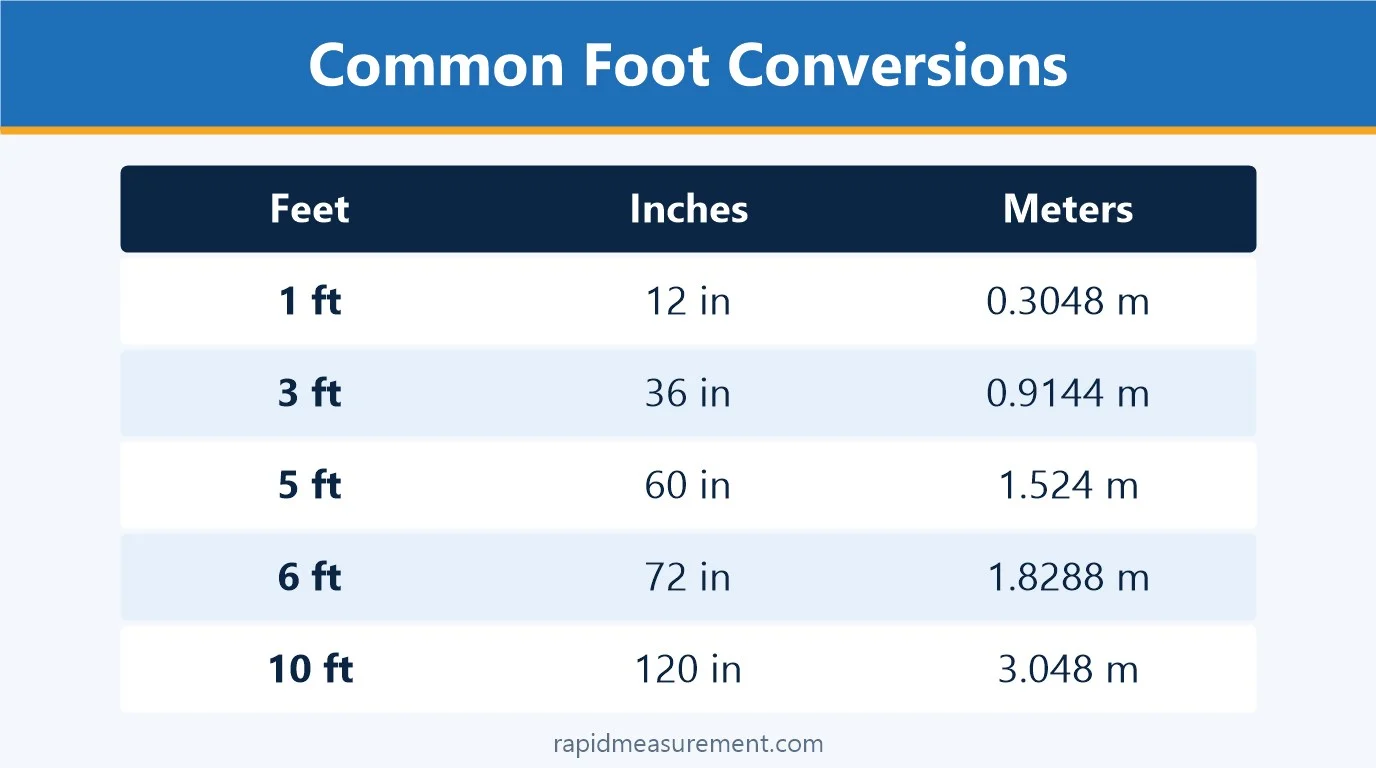
| Feet | Inches | Meters |
|---|---|---|
| 1 ft | 12 in | 0.30 m |
| 3 ft | 36 in | 0.91 m |
| 5 ft | 60 in | 1.52 m |
| 6 ft | 72 in | 1.83 m |
| 10 ft | 120 in | 3.05 m |
Feet in Everyday Use
- Height: Americans describe adult height in feet and inches (like 5’10”), rather than centimeters.
- Real estate: Room dimensions and square footage in the US are measured and advertised in feet.
- Aviation: Altitude is measured in feet worldwide, even in countries that use meters for everything else on the ground.
- Elevation: US topographic maps and hiking trail signs typically list elevation gain in feet.
Why the Foot Persists Alongside the Meter
Even in fields that otherwise use metric measurements, the foot has stubbornly held on in a few specific niches — most notably aviation, where international standards fixed altitude reporting in feet decades ago and have never switched, regardless of which system a country uses on the ground. This is a reminder that unit adoption isn’t purely rational; once an industry standardizes on something, the cost of switching often outweighs the benefit, even generations later.
Feet in Specific Fields
- Real estate: Square footage is the primary way US homes and commercial spaces are marketed and valued.
- Nautical measurement: Boat lengths are traditionally given in feet, even in countries otherwise fully metric.
- Rock climbing and mountaineering: Route heights and pitch lengths in the US are commonly described in feet.
- Ceiling heights: US building codes and listings specify minimum ceiling heights in feet rather than meters.
The Foot’s Fractional Structure
Like the inch it’s built from, the foot doesn’t divide neatly into tenths — instead, measurements smaller than a foot are usually expressed in inches (12 to a foot) rather than decimal fractions of a foot. A measurement like “5.5 feet” is mathematically valid but rarely used in practice; “5 feet 6 inches” is how the same length is almost always expressed, reflecting the imperial system’s inch-based subdivision habit.
A Brief History of Foot Standardization
Before the 1959 International Yard and Pound Agreement, the foot (like the inch) had slightly different definitions in different English-speaking countries — a discrepancy of a few parts per million that mattered increasingly as manufacturing and trade became more precise and international. Fixing the foot at exactly 0.3048 meters, alongside the inch, yard, and pound, eliminated that inconsistency permanently across the US, UK, Canada, Australia, South Africa, and New Zealand.
Feet vs. Meters in Global Construction
Most of the world’s construction industry works entirely in meters and centimeters, which is one of the more practical everyday consequences of the metric/imperial divide — an architectural drawing produced in the US typically needs full unit conversion before it can be used by a construction team in a metric country, and vice versa. This is part of why large multinational construction and engineering firms often maintain staff fluent in both systems.
Frequently Asked Questions
What is a foot?
A foot is a unit of length equal to 12 inches, or about 30.48 centimeters.
How many inches are in a foot?
There are exactly 12 inches in one foot.
How many feet are in a yard?
There are exactly 3 feet in one yard.
Is a foot bigger than a meter?
No. A foot is smaller — it takes about 3.28 feet to equal one meter.
Why is it called a “foot”?
Because the unit was originally based on the length of an actual human foot, a common and intuitive way ancient and medieval societies standardized measurements before formal international definitions existed.
How many centimeters are in a foot?
There are exactly 30.48 centimeters in one foot.
Why do measurements smaller than a foot use inches instead of decimals?
It’s a tradition inherited from carpentry and everyday speech — saying “5 feet 6 inches” is more intuitive to most English speakers than “5.5 feet,” even though both describe the same length.
Do any metric countries still use feet for anything?
Yes — aviation altitude is measured in feet essentially everywhere in the world, including fully metric countries, due to a long-standing international aviation standard.
How tall is the average adult in feet?
Average adult height worldwide is roughly 5.5 to 5.9 feet, though this varies noticeably by country and population.
The Foot in Architecture and Design History
Long before formal standardization, architects and builders across many cultures independently gravitated toward foot-based proportional systems, since a foot roughly matches a comfortable step length and a workable subdivision of common room dimensions. Classical Greek and Roman architecture used foot-based modules extensively in building design, a practice that influenced European architectural tradition for centuries afterward, well before the English foot was legally fixed to its modern length.
Feet, Basketball, and Height Culture
Height described in feet and inches has taken on outsized cultural significance in American sports, particularly basketball, where a player’s listed height (like “6’8″”) becomes part of their public identity in a way that a metric equivalent rarely carries the same weight. This is a good example of how a measurement unit can become embedded in culture well beyond its practical function — the number itself becomes shorthand for physical presence and athletic potential.
The Foot’s Surprising Survival in Aviation
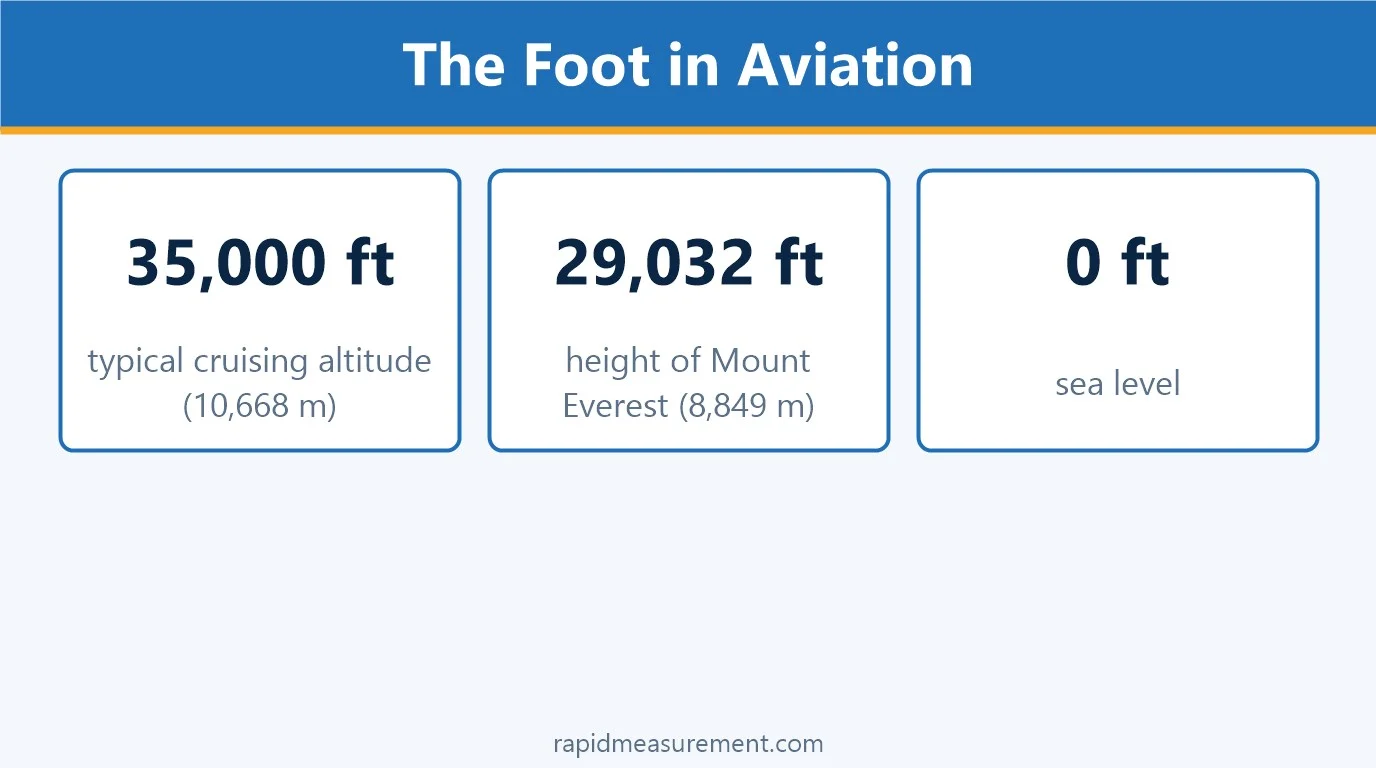
Of all the places the foot has held on despite metric adoption elsewhere, aviation is the most universal — pilots and air traffic controllers worldwide communicate altitude in feet, a standard set by early international aviation agreements and never revisited even as those same countries metricated everything else about daily life. This makes the foot one of the very few imperial units with genuinely global, uncontested use in a specific technical domain, alongside the troy ounce in precious metals trading.
Related Articles
1 Meter to Feet: 1 m = 3.28 ft
1 meter equals 3.28 feet, or 3 ft 3.37 in. See the formula, a meters to feet table, meter vs yard and a quick mental shortcut.
10 Inches to Centimeters: 10 in = 25.4 cm
10 inches equals 25.4 centimeters. Get the formula, a 6-14 inch table, everyday 10 inch objects and a quick mental method.

170 cm to Feet and Inches: 5 ft 6.9 in
170 centimeters equals 5 feet 6.9 inches. See the cm to feet formula, a 160-185 cm height chart and an easy 5-foot anchor trick.
6 Feet to Centimeters: 6 ft = 182.88 cm
6 feet equals 182.88 centimeters. Get the formula, a 6 ft 0 in to 6 ft 5 in height chart in cm and a simple way to convert feet and inches.