100 Kilograms to Pounds: Quick & Easy Conversion
100 Kilograms to Pounds
100 kilograms equals 220.46 pounds. That’s the number most people searching for this are after, so here it is right away — along with the formula, a wider reference table, and a few comparisons that make 220 pounds easier to picture. For a general reference, see the Wikipedia entry on kilograms.
The Conversion Formula
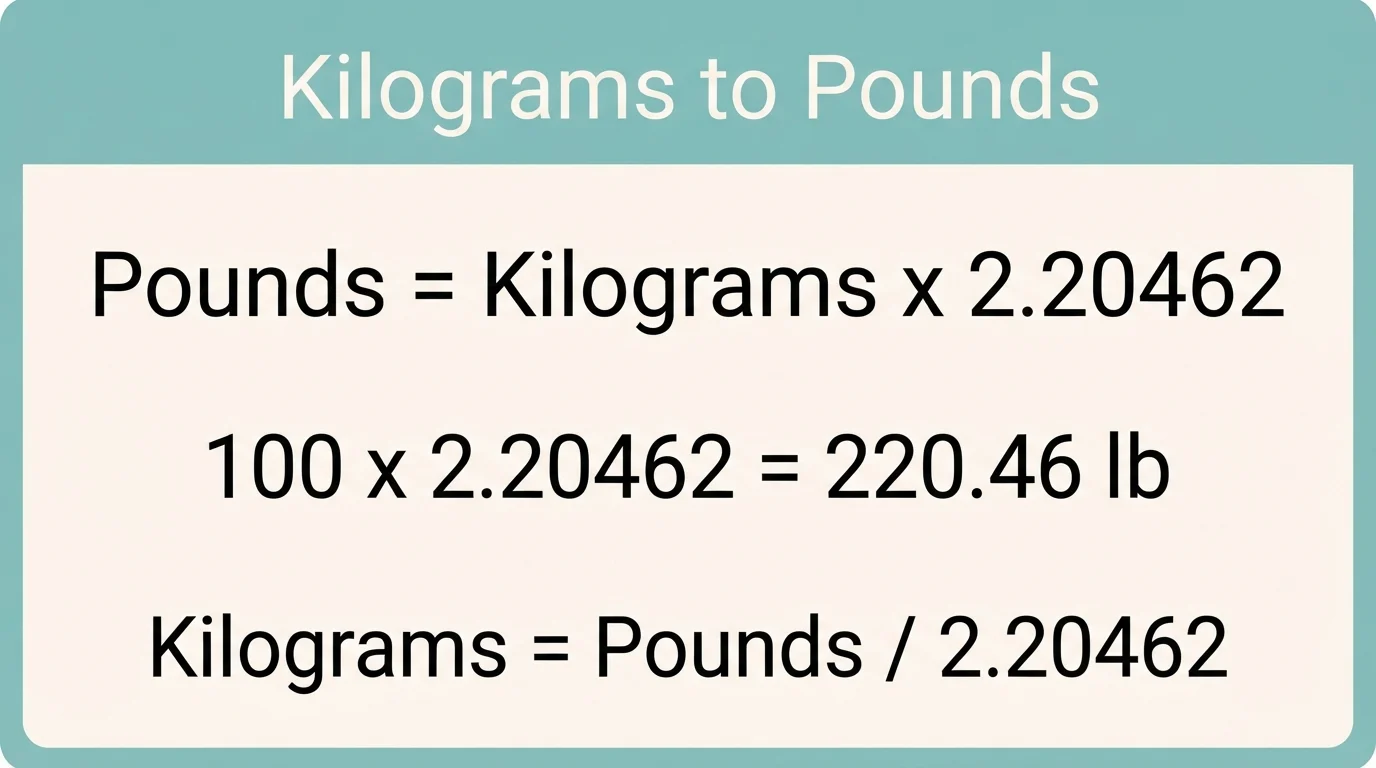
Pounds = Kilograms × 2.20462
For 100 kg:
100 × 2.20462 = 220.46 lb
In pounds and ounces together, that’s 220 lb 7.4 oz.
Kilograms to Pounds Reference Table
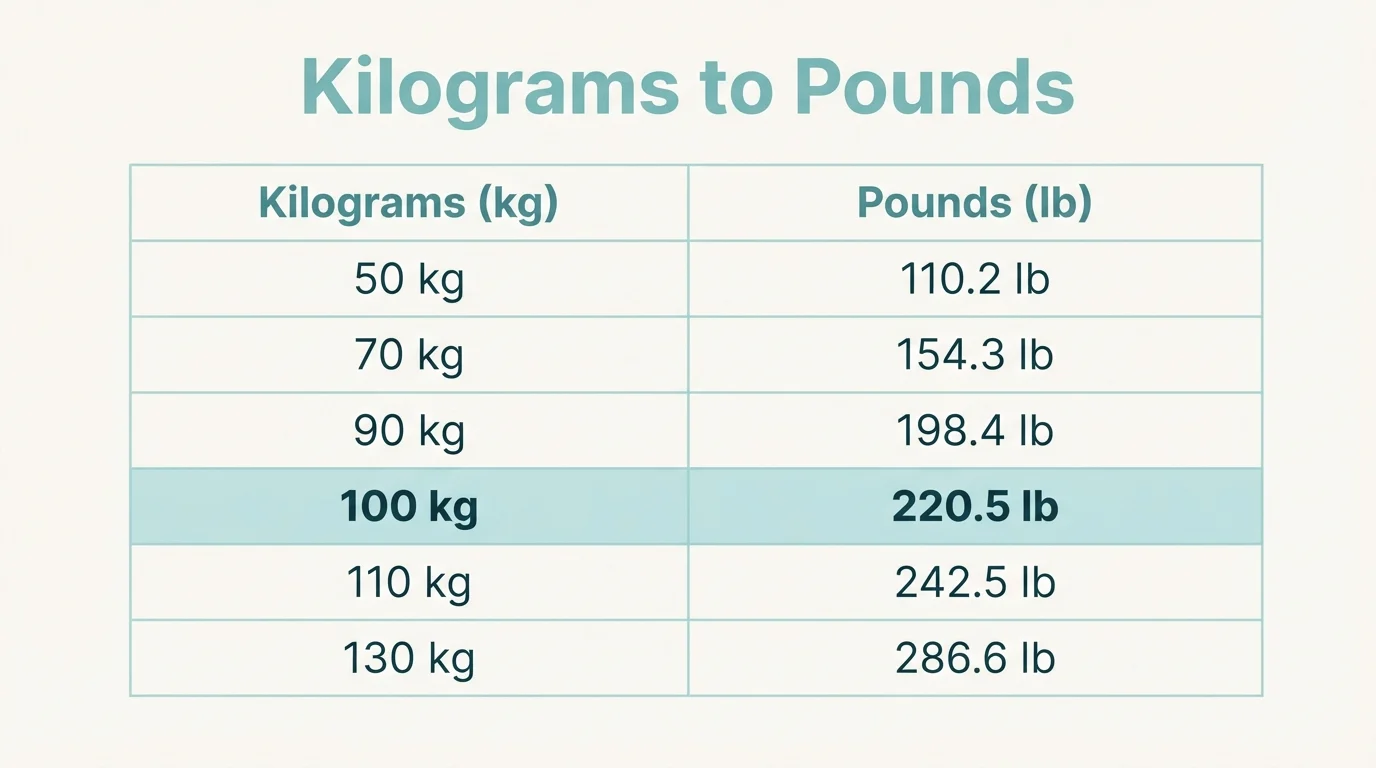
| Kilograms | Pounds |
|---|---|
| 50 kg | 110.2 lb |
| 60 kg | 132.3 lb |
| 70 kg | 154.3 lb |
| 80 kg | 176.4 lb |
| 90 kg | 198.4 lb |
| 100 kg | 220.5 lb |
| 110 kg | 242.5 lb |
| 120 kg | 264.6 lb |
| 130 kg | 286.6 lb |
A Quick No-Calculator Trick
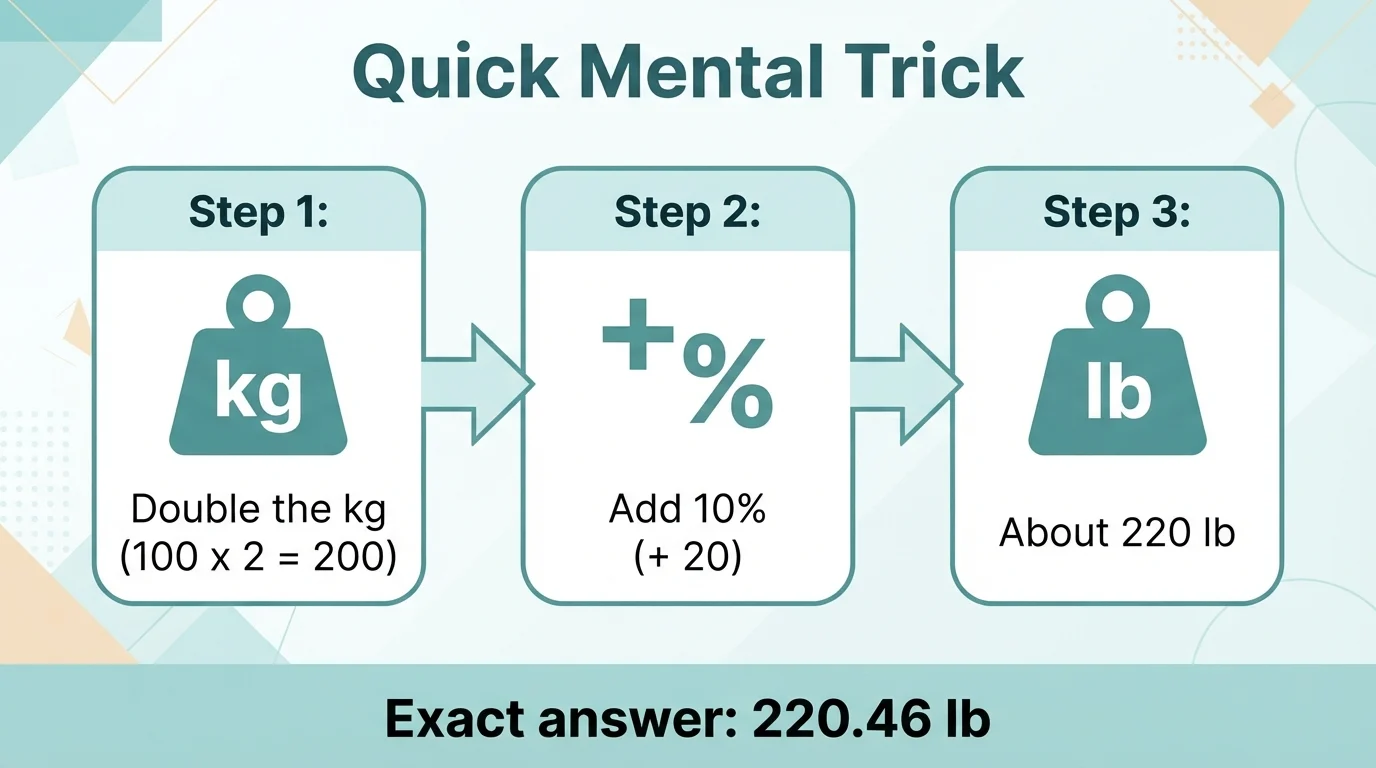
Double the kilogram number, then add 10% of that result. For 100 kg: double it to 200, add 10% (20), and you land on 220 — very close to the exact 220.46 lb answer. This shortcut works well for quick mental estimates.
What Does 100 kg Actually Feel Like?
100 kilograms (220 pounds) is a substantial weight — heavier than the average adult. Some comparisons:
- Heavier than most adult humans, including many professional athletes outside of heavyweight sports
- About the weight of an upright piano (smaller models)
- Roughly two large adult men combined
- Similar to a large adult male gorilla
Where the Kilogram and Pound Come From
The kilogram is the base unit of mass in the metric (SI) system, originally tied to a physical platinum-iridium cylinder and, since 2019, redefined using a fixed value of the Planck constant for extreme precision.
The pound has a messier history, tracing back through British imperial units. Since 1959, it’s been fixed by international agreement at exactly 0.45359237 kilograms — which is where the 2.20462 conversion factor comes from. Technically, both units measure mass, not weight, even though people use “pounds” to talk about weight every day — that distinction is explained in more depth in our mass vs. weight guide.
Common Uses for This Conversion
100 kg comes up as a threshold more often than you’d expect:
- Checked baggage limits — many airlines cap excess or oversized baggage allowances around this weight.
- Gym and powerlifting — 100 kg (220 lb) is a common milestone barbell load for squats and deadlifts.
- Shipping and freight — carriers often price parcels differently once they cross the 100 kg mark.
- Medical and clinical contexts — body weight readings near 100 kg are a frequent reference point in health guidelines published in kilograms.
Converting Pounds Back to Kilograms
Kilograms = Pounds ÷ 2.20462
220.46 pounds divided by 2.20462 brings you right back to 100 kg.
Frequently Asked Questions
How many pounds is 100 kg?
100 kilograms equals 220.46 pounds.
What is 100 kilos in pounds, rounded?
Rounded to the nearest whole number, 100 kg is about 220 pounds.
Is 100 kg a lot of weight for a person?
Yes — 100 kg (220 lb) is well above the global average adult body weight and is generally categorized as a heavier body weight range.
How do I convert a smaller kilogram number, like 45 kg?
The same formula applies: multiply by 2.20462. For 45 kg specifically, that works out to about 99.2 pounds — just under the 100-pound mark.
Why isn’t 100 kg exactly 220 pounds?
Because the conversion factor (2.20462) isn’t a round number — it comes from the exact legal definition of the pound in kilograms, so most kilogram values convert to a pound figure with a decimal.
Is there a dedicated guide to the kilogram?
Yes — see our full guide to the kilogram.
What about the pound itself?
See our full guide to the pound for its history and everyday uses.
FAQ
How many pounds is 100 kg?
100 kilograms equals 220.46 pounds.
How do you convert 100 kg to pounds?
Multiply the kilogram value by 2.20462. For 100 kg: 100 x 2.20462 = 220.46 lb.
What is 100 kilos in pounds rounded?
Rounded to the nearest whole number, 100 kg is about 220 pounds.
Is 100 kg a lot of weight for a person?
Yes - 100 kg (220 lb) is well above the global average adult body weight range.
Related Articles
1 Kilogram to Pounds: 1 kg = 2.2046 lb
1 kilogram equals 2.2046 pounds. Learn the exact factor, see a kg to lb table, how the kilogram is defined and a quick mental shortcut.
250 Pounds to Kilograms: 250 lb = 113.4 kg
250 pounds equals 113.4 kilograms. See the formula, a 200-300 lb table, chair and gym equipment limits, and a quick way to estimate it.
120 Pounds to Kilograms: 120 lb = 54.43 kg
120 pounds equals 54.43 kilograms. Get the lb to kg formula, a 100-140 lb table, body weight and boxing context, and an easy estimate.
90 Kilograms to Pounds: 90 kg = 198.42 lb
90 kilograms equals 198.42 pounds. See the formula, a 80-100 kg table, how 90 kg compares with 200 lb, and a simple mental shortcut.