How Big Is an Inch? Size Comparisons for 1-12 Inches

How Big Is an Inch?
An inch is about the length of the top joint of an adult thumb, or 2.54 centimeters. It’s one of the smallest common units in the imperial system, used for everything from screen sizes to screw lengths.
For background on the unit itself, see the inch entry on Wikipedia.
Everyday Objects That Are About 1 Inch
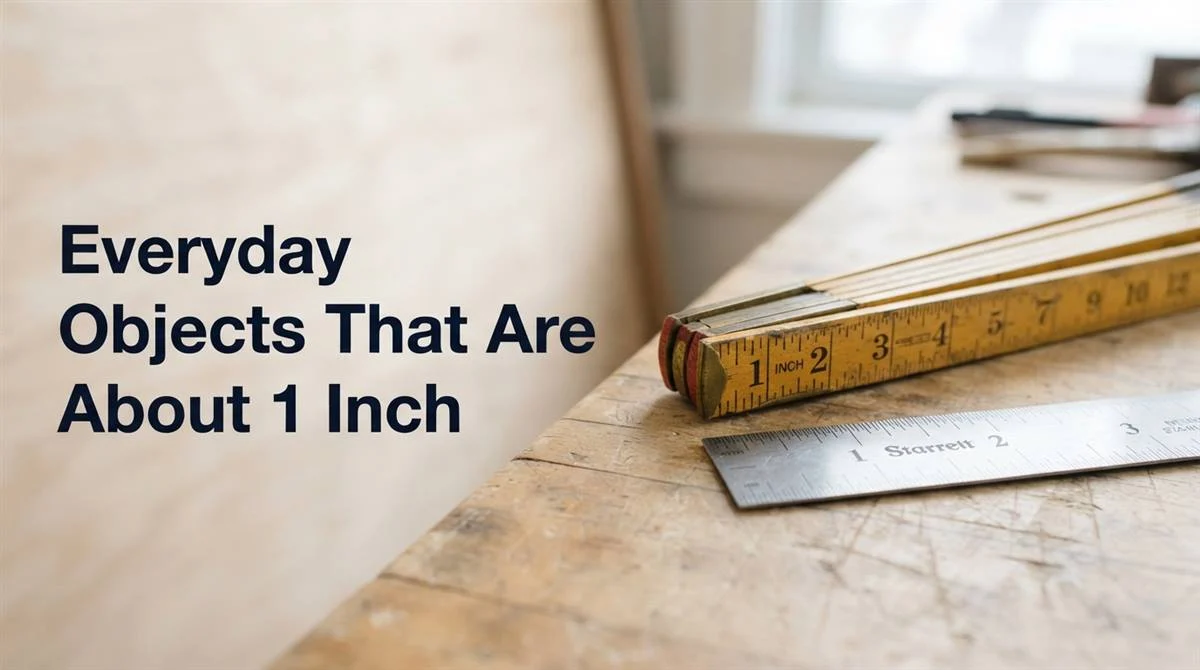
| Object | Approximate Size |
|---|---|
| Thumb (top joint, tip to first knuckle) | ≈ 1 in |
| A quarter (US coin) diameter | ≈ 1 in |
| A large paperclip, unfolded segment | ≈ 1 in |
| A standard door key, width | ≈ 1 in |
Size Chart: 1 to 12 Inches
| Inches | Everyday Comparison |
|---|---|
| 1 in | Top joint of a thumb; a quarter’s diameter |
| 2 in | Width of a golf ball; a AA battery’s length |
| 3 in | Width of a standard smartphone |
| 4 in | Height of a standard light switch plate |
| 5 in | Length of a dollar bill’s short side |
| 6 in | Length of a standard pen or a small ruler section |
| 7 in | A small dinner plate’s diameter |
| 9 in | Length of a standard pencil (unsharpened, new) |
| 12 in | 1 foot; the length of a standard ruler |
Why the Thumb Comparison Exists
The word “inch” descends from the Latin “uncia,” meaning a twelfth part, and for centuries the unit was informally measured against the width or top joint of an adult thumb before standardized rulers were common. That’s part of why “rule of thumb” survives as an English idiom for a rough, practical estimate rather than a precise measurement – it’s a literal reference to using body parts as makeshift measuring tools.
How to Estimate an Inch Without a Ruler
Beyond the thumb-joint method, a few other quick body-based references work well: the width of an adult’s index finger at the first knuckle is close to 1 inch for many people, and a US quarter measures almost exactly 0.955 inches across, close enough to 1 inch for a rough estimate. None of these are exact, since hand size varies from person to person, but they’re useful for a fast “is this roughly an inch” check when no tape measure is on hand.

Inches in Everyday Measurement
| Context | Typical Inch Measurement |
|---|---|
| Smartphone screens | 6 – 7 in (diagonal) |
| Laptop screens | 13 – 16 in (diagonal) |
| Pizza (small/medium/large) | 10 / 12 / 14 in (diameter) |
| Standard printer paper (US Letter) | 8.5 × 11 in |
| Wood screws | 0.5 – 4 in (length) |
Inches Compared to Centimeters
Since 1 inch equals exactly 2.54 cm, an inch is noticeably larger than a centimeter – roughly two and a half times the length. This is a common point of confusion for anyone switching between a US ruler marked in inches and a metric ruler marked in centimeters, since a “5” on one scale and a “5” on the other represent very different physical lengths.
Visualizing Larger Inch Measurements
Beyond the 1-12 inch range, a few larger benchmarks help anchor bigger numbers: 18 inches is close to the length of a standard ruler and a half, or the width of a typical kitchen cabinet; 24 inches is about the width of a standard interior door; 36 inches is exactly 1 yard and roughly the height of a kitchen countertop. Chaining these mental anchors together – “this looks like about two rulers” or “about door-width” – makes it much easier to estimate an unfamiliar measurement in inches without doing math.
Precision and Fractions of an Inch
Unlike the metric system, which splits units into tenths, US measuring tapes and rulers traditionally divide each inch into halves, quarters, eighths, and sixteenths (and sometimes thirty-seconds) rather than decimals. A carpentry measurement like “3 and 5/8 inches” is standard practice in US woodworking and construction, and reading these fractional markings accurately is a skill in itself – one reason many trades also keep a decimal-equivalent chart on hand for quick reference.

Related Conversions
See also inches to feet conversion chart for larger lengths, and what is an inch for the unit’s formal definition and history.
Frequently Asked Questions
What everyday object is exactly 1 inch?
A US quarter is very close to 1 inch in diameter (0.955 in), and the top joint of an adult thumb is a commonly used rough approximation.
How big is 6 inches compared to a phone?
6 inches is about the length (not width) of a large modern smartphone, or roughly the length of a standard pen.
How many centimeters is an inch?
1 inch equals exactly 2.54 centimeters.
Why is an inch called an inch?
The name comes from the Latin word “uncia,” meaning a twelfth part – originally a twelfth of a Roman foot, which is close to how a modern inch relates to a modern foot (1/12).
How can I estimate an inch without a ruler?
Use the top joint of your thumb or the diameter of a US quarter (0.955 in) as a rough reference for 1 inch.
FAQ
What everyday object is exactly 1 inch?
A US quarter is very close to 1 inch in diameter (0.955 in), and the top joint of an adult thumb is a commonly used rough approximation.
How big is 6 inches compared to a phone?
6 inches is about the length (not width) of a large modern smartphone, or roughly the length of a standard pen.
How many centimeters is an inch?
1 inch equals exactly 2.54 centimeters.
Why is an inch called an inch?
The name comes from the Latin word "uncia," meaning a twelfth part - originally a twelfth of a Roman foot, which is close to how a modern inch relates to a modern foot (1/12).
How can I estimate an inch without a ruler?
Use the top joint of your thumb or the diameter of a US quarter (0.955 in) as a rough reference for 1 inch.
Related Articles

How Many Miles Is a 5K? (3.1 Miles + Finish Times)
How many miles is a 5K? A 5K is 3.1 miles (5 kilometers). See average 5K times for walking and running, pace charts and other race distances.

How Many Miles Is 10,000 Steps? (By Height & Pace)
How many miles is 10000 steps? For most adults it is about 4 to 5 miles. See miles by height and stride, walking time and calories burned.

How Many Steps in a Mile? (Walking & Running Chart)
How many steps in a mile? Most adults take 2,000 to 2,500 walking steps per mile. See steps by height, running vs walking, and a formula.

How Many Meters in a Mile? (1,609.34 m Explained)
How many meters in a mile? There are 1,609.344 meters in 1 mile. See a miles to meters chart, the 1600 m vs mile race and nautical miles.