What Is a Millimeter?
What Is a Millimeter?
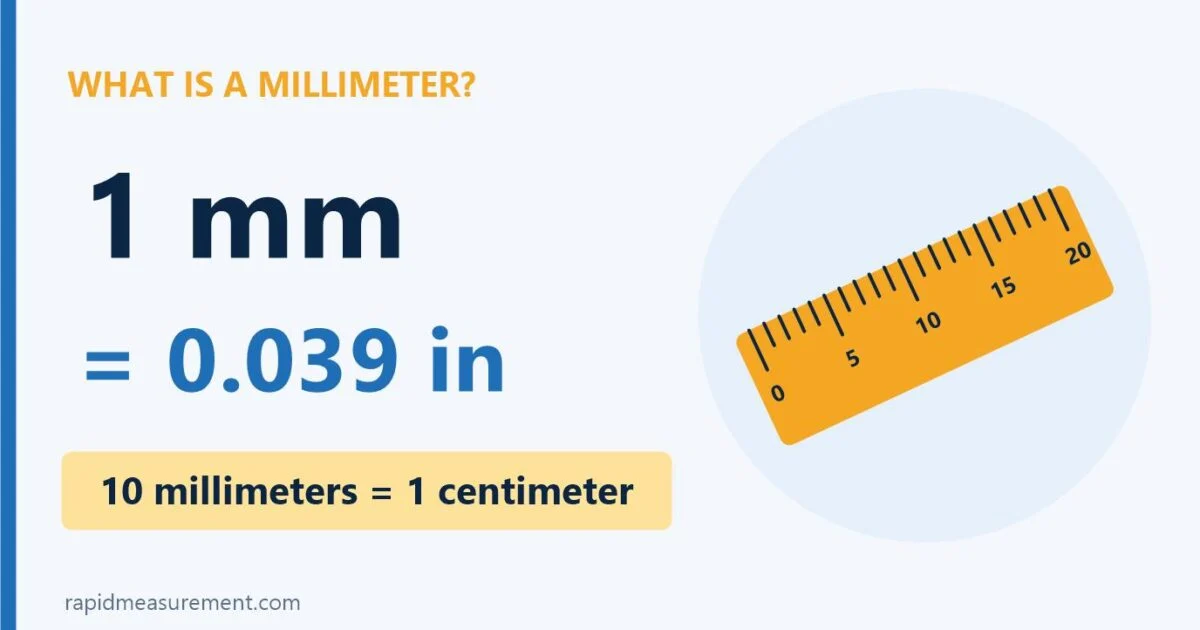
A millimeter (mm) is a metric unit of length equal to one-thousandth of a meter, or one-tenth of a centimeter. It’s the go-to unit for anything too small to measure conveniently in centimeters — the smallest division typically marked on a standard ruler. For a general reference, see the Wikipedia entry on millimeter.
How Big Is a Millimeter?

A millimeter is tiny — about the thickness of a credit card, or the width of a grain of rice. It’s small enough that most people can’t estimate it precisely without holding a ruler or tool up to the object directly.
| Object | Approx. Size |
|---|---|
| Credit card thickness | ~0.76 mm |
| Grain of rice (width) | ~2-3 mm |
| Pencil lead tip | ~1-2 mm |
| Sesame seed | ~2 mm |
Millimeters Compared to Other Units

- 1 mm = 0.1 centimeters — 10 millimeters make one centimeter; see our full guide to centimeters.
- 1 mm = 0.001 meters — 1,000 millimeters make one meter.
- 1 mm ≈ 0.03937 inches — about 1/25th of an inch.
So what’s smaller than a millimeter? Very little in everyday measurement — most rulers don’t mark anything finer, and anything below this scale (like the width of a human hair, roughly 0.07 mm) typically requires specialized tools to measure at all.
Why the Millimeter Exists
Centimeters are precise enough for most everyday tasks, but engineering, manufacturing, and medicine often need finer resolution than a centimeter allows. A tolerance of “plus or minus one centimeter” is far too loose for machine parts, eyeglass lenses, or surgical measurements — millimeters (and sometimes fractions of a millimeter) are where that real precision lives.
How to Read Millimeters on a Ruler
On a standard metric ruler, the small, unlabeled tick marks between each centimeter number are millimeters — there are always 10 of them per centimeter. To read a precise measurement, count the whole centimeters first, then count the small ticks past the last labeled number. A ruler used correctly can measure down to the nearest millimeter by eye, and down to about half a millimeter with careful estimation between ticks.
Common Millimeter Conversions
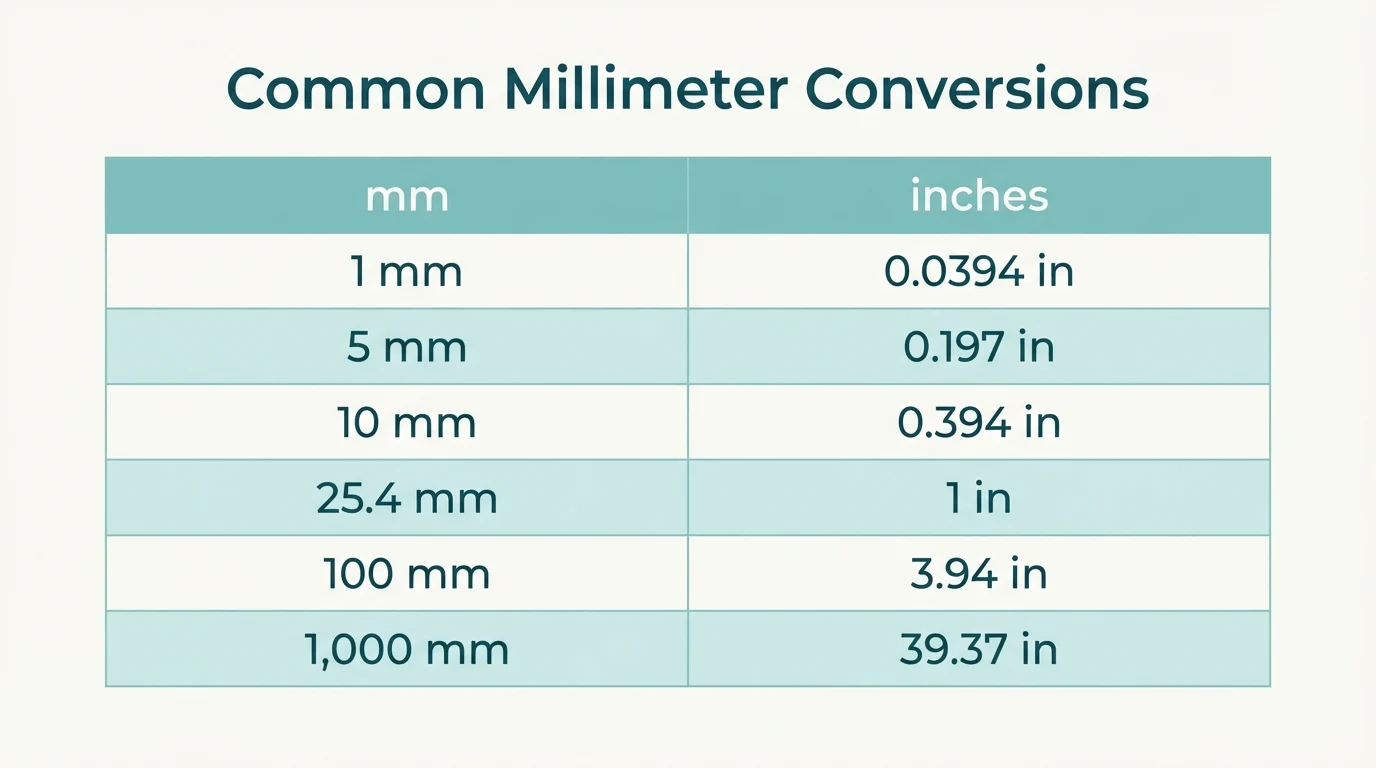
| Millimeters | Centimeters | Inches |
|---|---|---|
| 1 mm | 0.1 cm | 0.039 in |
| 5 mm | 0.5 cm | 0.197 in |
| 10 mm | 1 cm | 0.394 in |
| 25 mm | 2.5 cm | 0.984 in |
| 100 mm | 10 cm | 3.937 in |
Millimeters in Everyday Use
- Eyewear: Lens thickness and frame measurements are specified in millimeters for precision fit.
- Photography: Camera lens focal lengths (like “50mm”) are always given in millimeters.
- Engineering and manufacturing: Machine part tolerances are commonly specified to the millimeter or fraction of a millimeter.
- Medicine: Blood pressure (mmHg), tumor size, and needle gauges often reference millimeters.
- Rainfall measurement: Weather reports in most of the world measure precipitation in millimeters.
Common Millimeter Mistakes
- Confusing mm and cm — a 5 mm gap and a 5 cm gap differ by a factor of 10, a mistake that matters a lot in engineering and construction.
- Assuming a millimeter is “basically nothing” — in precision contexts like eyewear or machining, a single millimeter of error can make a part unusable.
- Rounding away small measurements — dropping millimeter-level detail when converting to inches can introduce noticeable error in small objects.
Millimeters vs. Centimeters: Which Should You Use?

The choice comes down to how much precision the task actually needs. Measuring a room, a piece of furniture, or a person’s height works fine in centimeters — the extra precision of millimeters would just add clutter to the number. But measuring a screw, a lens, a gap between machine parts, or anything where a small error changes whether something fits calls for millimeters instead.
A helpful rule of thumb: if rounding to the nearest centimeter would still get the job done, use centimeters. If rounding to the nearest centimeter could cause a real problem — a part that doesn’t fit, a lens that sits wrong — millimeters are the safer unit.
A Brief History of the Millimeter
Like the centimeter, the millimeter was built into the metric system from its creation in 1790s France as a clean, decimal-based subdivision of the meter. It didn’t see wide practical use until precision manufacturing and engineering matured enough to need it — early metric adoption focused mostly on centimeters and meters for everyday measurement, with millimeters becoming essential later as tolerances in machining and optics grew tighter.
Millimeters in Technical Fields
Beyond the examples above, millimeters are the default unit in several specialized fields:
- Firearms and ammunition: Calibers like “9mm” refer directly to the bullet’s diameter in millimeters.
- 3D printing: Layer height and print precision are almost always specified in fractions of a millimeter.
- Watchmaking: Case diameters and component sizes are measured in millimeters for the tight tolerances the craft requires.
Frequently Asked Questions
What is a millimeter?
A millimeter is a metric unit of length equal to one-tenth of a centimeter, or one-thousandth of a meter.
How many millimeters are in a centimeter?
There are exactly 10 millimeters in one centimeter.
Is a millimeter bigger or smaller than a centimeter?
Smaller. A millimeter is one-tenth the size of a centimeter.
What is smaller than a millimeter?
Very little in everyday use — a human hair (about 0.07 mm) is one of the few commonly referenced things smaller than a millimeter.
How many millimeters are in an inch?
There are exactly 25.4 millimeters in one inch, by international definition.
Why do rulers stop at millimeters instead of going smaller?
Millimeters are about as fine as the human eye can reliably read on a physical ruler without magnification — anything smaller requires specialized instruments like calipers or microscopes.
How does a millimeter compare to an inch’s smallest markings?
Imperial rulers often mark down to 1/16 of an inch (about 1.6 mm), which is coarser than a millimeter — one reason metric measurements are often considered more precise for fine work at a glance.
Tools Used to Measure in Millimeters
Beyond a standard ruler, several tools are built specifically around millimeter precision:
- Calipers — both digital and vernier calipers commonly measure to a tenth of a millimeter or finer, standard in machining and manufacturing.
- Micrometers — used when even a caliper isn’t precise enough, capable of measuring to hundredths of a millimeter.
- Optical measuring devices — used in eyewear and precision manufacturing where physical contact with the object being measured isn’t practical.
For most everyday purposes, though, a simple ruler with millimeter markings is more than sufficient — these specialized tools only become necessary once tolerances tighten beyond what the naked eye and a steady hand can reliably achieve.
Millimeters and the Metric System’s Design Philosophy
The millimeter is a good example of what makes the metric system work so well as a complete package rather than just a collection of arbitrary units. Because every unit relates to every other by a power of 10, a single measuring instrument — a ruler, a tape measure, a caliper — can express a result in millimeters, centimeters, or meters simply by shifting the decimal point, without ever needing a separate conversion chart the way imperial units often do. This is part of why fields that require frequent unit-scale switching, like engineering and manufacturing, lean so heavily on metric measurement even in countries that otherwise use imperial units for daily life.
Is there a dedicated guide to the meter?
Yes — see our full guide to the meter, the millimeter’s larger metric sibling.
Related Articles
1 Meter to Feet: 1 m = 3.28 ft
1 meter equals 3.28 feet, or 3 ft 3.37 in. See the formula, a meters to feet table, meter vs yard and a quick mental shortcut.
10 Inches to Centimeters: 10 in = 25.4 cm
10 inches equals 25.4 centimeters. Get the formula, a 6-14 inch table, everyday 10 inch objects and a quick mental method.

170 cm to Feet and Inches: 5 ft 6.9 in
170 centimeters equals 5 feet 6.9 inches. See the cm to feet formula, a 160-185 cm height chart and an easy 5-foot anchor trick.
6 Feet to Centimeters: 6 ft = 182.88 cm
6 feet equals 182.88 centimeters. Get the formula, a 6 ft 0 in to 6 ft 5 in height chart in cm and a simple way to convert feet and inches.